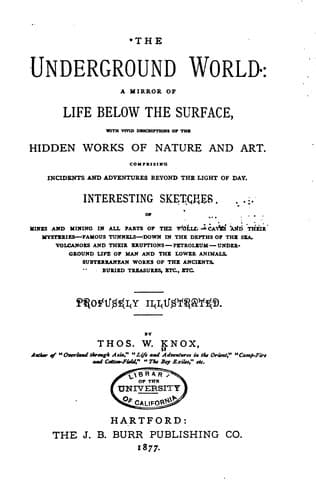
The Underground World: A mirror of life below the surfaceKnox, Thomas Wallace
History
The Underground World: A mirror of life below the surface
Knox, Thomas Wallace
Caves; Mines and mineral resources; Social history -- 19th century; Tunnels
[1] The term Zoöphyte is applied to simple polyps and compound
individuals consisting of many polyps united together, as in most
corals. They often branch like vegetation, and the polyps resemble
flowers in form.
“On examining a piece of coral, it is seen to be full of little holes,
popularly supposed to be the places for the stomachs of the animals,
but this is not so, at all; the coral animal does not form a secretion
around it like the mollusks,[2] but inside, between the two folds of
its skin. Coral is, therefore, the bones and not the skull of the
animal. As before stated, these animals work in societies or colonies,
and their tendency is to repeat the forms peculiar to each species;
thus we have corals shaped like a hand, like the branches of trees,
like mushrooms, like a brain, with its convolutions. They grow and
multiply in these societies by budding or gemmation. The side of the
animal begins to bulge out, and the protuberance so formed develops
into a new mouth, which soon eats and digests for itself, but does
not separate from its parent. This process goes on symmetrically, and
produces the variety of regular shapes just described.
[2] Mollusks are invertebrate animals, having a soft, fleshy body,
which is inarticulate, and not radiate internally.
“Some distance below the surface, we no longer find these beautiful
shapes, but a dense, solid, coral rock. Take for instance, the coral
reefs of Florida. Beginning one hundred and twenty feet below the
surface, we first find about thirty feet of massive rock, then the
astræa,[3] then the meandrina,[4] and about ten feet below the surface
the palmata or hand-shaped coral. In the shallow mud between the
reefs and the continent, there are multitudes of branching corals
of the most beautiful forms, colors, and delicacy of structure. The
production of coral rock is explained partly by the mechanical action
of the waves, and partly by the destruction of the coral insect by the
sea urchin and other animals that feed on it. The waves disintegrate
the structure formed by the animal, and then roll back the coral sand,
thus produced upon it, where it undergoes a process of induration in
the course of time.
[3] Astræa, a coral in the shape of a star.
[4] Meandrina, a genus of corals with meandering cells, as the
brain-stone coral.
“It is an interesting question how the structure ever rises above the
water level, seeing that the animal which makes it cannot live out of
the water. The little architects retain enough sea water to last them
over until the next tide, and are so enabled to work up to the highest
watermark. Actinia have been observed all closed up on the rock at low
water, and then suddenly opened like magnificent flowers, five and six
inches in diameter, when the tide rose.”
Public-domain text, read in full here on John Shaqi.
Reviews
Reviews
No reviews yet
Be the first to share your thoughts on this work.
Elsewhere in the archive
Join the Discussion
Join the discussion
Sign in to leave a comment or review.
Sign InorCreate an account