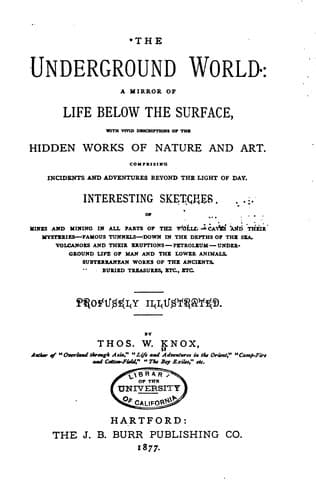
The Underground World: A mirror of life below the surfaceKnox, Thomas Wallace
History
The Underground World: A mirror of life below the surface
Knox, Thomas Wallace
Caves; Mines and mineral resources; Social history -- 19th century; Tunnels
So far, what Mr. Agassiz says of them; now let us try and look at them
ourselves. In the hot, summer months, when the waters are bringing
forth the moving creature that has life, millions of diminutive,
jelly-like spawn are thrown out by the parent animal. For a while,
they enjoy their freedom, and seem to luxuriate in the exercise of
their powers of locomotion, which they are never hereafter to recover;
but soon they become weary, and settle down upon some firm, stationary
body. At once they begin to change their form; they become star-like,
the mouth being surrounded by tentacles, very much as the center of a
flower is surrounded by its leaves. After some time, each one of these
ray-like parts pushes out extensions, which in their turn assume the
shape of tiny stars, and establish their own existence by means of an
independent mouth. In the meanwhile, lime has been deposited at the
base of the little animal, by its own unceasing activity, and forms
a close-fitting foot, which adheres firmly to the rock. Upon this
slender foundation arises another layer, and thus by incessant labor,
story upon story, until at last a tree has grown up with branches
spreading in all directions. But where the plants of the upper world
bear leaves and flowers, there buds forth here, from the hard stone, a
living, sensitive animal, moving at will, and clad in the gay form and
bright colors of a flower.
This flower is the animal itself, seen only in its native element, and
unfit for air and light. What we call coral is its house, outside of
which it prefers to live, rather than within.
How they build their dwelling, human eye has never seen. We only
know that the tiny animals, by some mysterious power, absorb without
ceasing the almost imperceptible particles of lime which are contained
in all salt-water, and deposit them, one by one, in the interior.
This is done, now more, now less actively; and the denser the deposit
is, the more valuable the coral. Gradually this substance hardens and
thickens, until, in the precious coral, the _Isis Nobiles_ of science,
a large tree is formed, which often reaches the size of a man’s waist.
It is perfectly solid and compact, and adorned on the surface with
delicate parallel lines. Thus, on the tree-shaped limestone, grows
the life-endowed body of the polypus; it moves, it feeds, it produces
others, and then is turned again into stone, burying itself in its own
rocky house, whilst on its grave new generations build unceasingly new
abodes.
This is the so-called blood-coral, the favorite of antiquity, and the
fashion of our day—next to the pearl, the most precious jewel of the
deep.
Public-domain text, read in full here on John Shaqi.
Reviews
Reviews
No reviews yet
Be the first to share your thoughts on this work.
Elsewhere in the archive
Join the Discussion
Join the discussion
Sign in to leave a comment or review.
Sign InorCreate an account