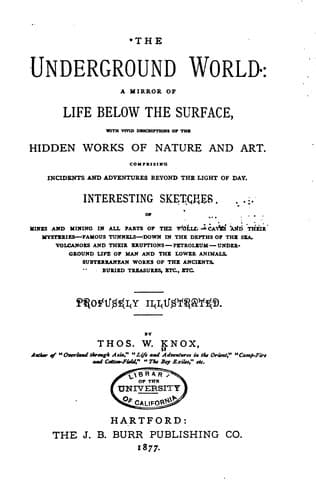
The Underground World: A mirror of life below the surfaceKnox, Thomas Wallace
History
The Underground World: A mirror of life below the surface
Knox, Thomas Wallace
Caves; Mines and mineral resources; Social history -- 19th century; Tunnels
Swiftly, and as silently as possible, their work was performed. The
watchman, from the place where he was bound, could not see, but he
could hear, and he knew they were at work with drills, blow-pipes,
wedges, and the other implements of the burglar’s trade. Hour after
hour passed, the watchman, bound and gagged, being guarded by his
vigilant keeper. In telling the story subsequently, he said he was
civilly treated by the man who guarded him. At his request the cords
that held his arms were loosened, and the gag in his mouth was placed
where it would least inconvenience him. Whenever he complained of
thirst, his keeper gave him a glass of water from a pitcher in the
room.
An hour or so before daylight the robbers opened the safe, and secured
their plunder. Hastily packing it into the bags that had contained
their tools, they departed, leaving their tools behind, and leaving
the watchman securely fastened in his chair. He was ordered not to
stir for an hour: bound as he was, he could not stir until some one
came to his assistance, so that the parting injunction of the thieves
was entirely superfluous. The amount of their plunder was never
positively made known to the public, but was understood to be not less
than two hundred thousand dollars—a very fair compensation for the
work of a single night.
[Sidenote: THE OCEAN BANK ROBBERY.]
Of the many successful bank robberies that have taken place on this
continent, the Ocean Bank burglary ranks among the foremost for
its ingenuity and skill, and for being a complete puzzle to the
most experienced detectives of the city of New York. Although an
investigation by the police authorities was begun within a few hours
after the discovery of the robbery, no clew was ever obtained, or, at
any rate, given to the public, of the perpetrators; and to this day
the whole matter has been involved in mystery, and probably will ever
remain so.
The maxim of war, that the reduction of every place, however strong,
is possible, must be equally true in the art of thievery. It is
evident that no vault can be made impregnable; no lock can be
contrived by human ingenuity, with all its mechanical appliances, that
will prove superior to other human ingenuity; no system of watching
can make property entirely safe against the patience and acuteness of
men who give good faculties to the science of stealing.
The premises occupied by the Ocean Bank were at the corner of
Greenwich and Fulton Streets, New York, a locality much frequented by
day and night. One would imagine that an attempt at robbery in this
locality must be detected very quickly, provided the policemen and the
watchers employed around the neighboring stores performed their duty.
The robbery occurred between one and three o’clock on the morning of
the 28th of June, 1869. It appears that there was no regular inside
watchman employed by the bank, but they had an out-door man employed
to watch the premises.
Public-domain text, read in full here on John Shaqi.
Reviews
Reviews
No reviews yet
Be the first to share your thoughts on this work.
Elsewhere in the archive
Join the Discussion
Join the discussion
Sign in to leave a comment or review.
Sign InorCreate an account