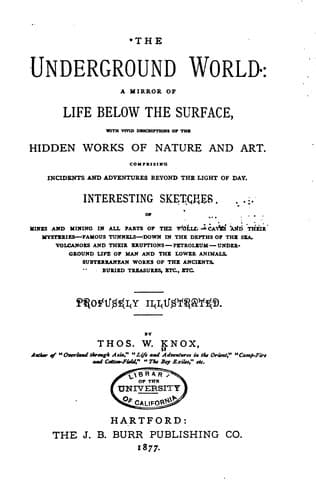
The Underground World: A mirror of life below the surfaceKnox, Thomas Wallace
History
The Underground World: A mirror of life below the surface
Knox, Thomas Wallace
Caves; Mines and mineral resources; Social history -- 19th century; Tunnels
It is supposed that the robbery was planned many weeks before it took
place, and one or more persons familiar with the thorough workings
of the bank were suspected of being, to some extent at least,
participators in the enterprise.
The basement of the premises in question was occupied by a Mr.
William Okell, a gentleman well known in the city, and doing business
as a broker. Having more room than he required for carrying on his
business, he rented out several small offices for business purposes.
In the early part of June, a man giving the name of Charles K. Cole,
and representing himself as an agent for an insurance company in
Chicago, engaged one of these rooms; and to him is given the credit of
planning the robbery, in connection with others.
Immediately above the office rented to Cole was the president’s
private office, and through the ceiling of this office an entrance
was made sufficient to admit a man’s body. From the subsequent
examination by the detectives, it appears that holes were drilled
through this ceiling from above and below, as the Brussels carpet in
the president’s room contained no holes, which would not have been the
case had the drilling been done entirely from the basement.
It was urged by some that this drilling through the ceiling and large
beams must have occupied weeks, while other experienced officers
asserted that it could have been accomplished in a few hours. One of
the severed beams was four inches thick by fourteen in width. Some
believed that an entrance was effected through the side door, and that
the person or persons had a good knowledge of the employees, where the
safes were, the contents of the vault and safes, and the key to the
combination lock.
[Sidenote: A STARTLING DISCOVERY.]
The discovery of the robbery was made by the colored man up stairs, on
Monday morning, when he opened the bank, in his usual way, to clean
the offices. He detected a strong smell of powder, and went into the
rear office to find out the cause of it. There he was astonished at
the view which met his Ethiopian eyes.
On the floor of this office were the vaults and safes. Here he
observed several caps of different descriptions, six or eight in
number; overcoats, blouses, and overalls, such as are used by
machinists; oil-cloths, rubber shoes, saws, bits, awls, jack-screws,
drills, lanterns, and every other kind of implement used by expert
thieves. The instruments were gathered together and taken into the
possession of the police, and a cabinet of four hundred pieces was
made of them.
The vault and safes were found to have been broken open; United States
bonds were lying scattered about, as well as large quantities of coin
and currency, mixed with which were small wedges, railway bonds,
copper coin, augers, chisels, flasks of powder, any quantity of cigar
stumps, which showed that the burglars took the situation very coolly,
pieces of chilled iron, fuses, gold certificates, and other valuable
securities.
Public-domain text, read in full here on John Shaqi.
Reviews
Reviews
No reviews yet
Be the first to share your thoughts on this work.
Elsewhere in the archive
Join the Discussion
Join the discussion
Sign in to leave a comment or review.
Sign InorCreate an account