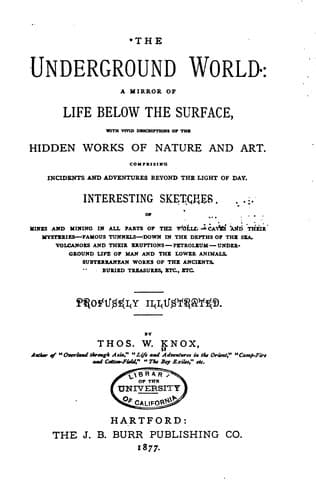
The Underground World: A mirror of life below the surfaceKnox, Thomas Wallace
History
The Underground World: A mirror of life below the surface
Knox, Thomas Wallace
Caves; Mines and mineral resources; Social history -- 19th century; Tunnels
The earliest form of sepulture was in the grave, a simple trench
a few feet in depth. With the dawn of civilization came the tomb,
rudely constructed of stones piled together, or cut out of the solid
rock. The most elaborate specimens of the latter kind of tomb are in
Egypt; thousands of years ago they were constructed, and to this day
they remain, and are regarded with wonder by travellers from all the
nations of the globe. The most extensive tombs of modern times bear
no comparison to those which are found in the lands bordering on the
Nile. The pyramids of Ghizeh, immense mounds of stone, and constructed
with the greatest care and engineering skill, are the tombs of the
rulers of Egypt in the days of her greatness and prosperity. The
pyramid of Cheops rises to a height of nearly five hundred feet, and
is of proportional width at its base. Down deep in its centre is the
coffin of the man whose name has been given to the pyramid; thousands
of years have passed since this huge tomb was constructed, and it will
doubtless remain for thousands of years to come. No tomb of modern
times approaches it in grandeur, or gives promise of outlasting it.
Though the opposite of underground in their character, and erected
rather in the interest of death than in that of life, the great
pyramids deserve a description here. Excavations were made for their
foundations, and the interior chambers, where rest the coffins of
those for whom they were erected, are, for all practical purposes, as
much underground as they would be in the deepest coal mine of England
or America. The pyramids are mostly on the west bank of the Nile, not
far from Cairo; tourists designing to visit them make Cairo their
starting-point, and from that city several groups are in full view.
Altogether about seventy pyramids have been counted in this region,
and the remains of many others are visible. Decay’s effacing fingers
are constantly at work; forty centuries have passed since the pyramids
were erected, and their durable character can be readily inferred
when we remember how long they have stood.
Public-domain text, read in full here on John Shaqi.
Reviews
Reviews
No reviews yet
Be the first to share your thoughts on this work.
Elsewhere in the archive
Join the Discussion
Join the discussion
Sign in to leave a comment or review.
Sign InorCreate an account