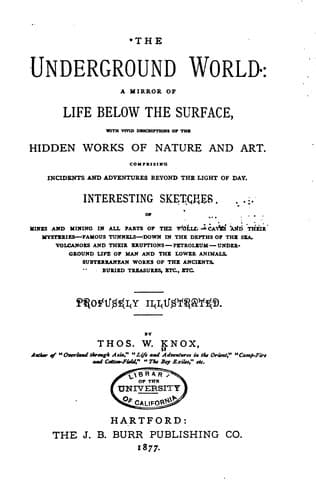
The Underground World: A mirror of life below the surfaceKnox, Thomas Wallace
History
The Underground World: A mirror of life below the surface
Knox, Thomas Wallace
Caves; Mines and mineral resources; Social history -- 19th century; Tunnels
A sepulchral chamber was first excavated in the rock, and during the
life of the king who was to repose within it, the work of building
the pyramid was pressed forward. It was generally completed before
he died, and therefore he had the consolation of knowing that he
would not be kept waiting around for his tomb to be constructed. The
structure was made over this chamber, an elegant coffin of stone being
first placed within it. A passage-way about four feet high and three
feet wide was kept open, so that the body of the king could be carried
to the sepulchral chamber when the proper time arrived for depositing
it in its coffin. The pyramid was practically solid, as the chamber
and passages leading to it were the only hollow spaces. The sides of
the pyramids were directed to the four cardinal points of the compass,
and their exactness in this particular leads to the supposition that
the ancients were acquainted with the principles of surveying as
practised by modern engineers.
[Sidenote: CONSTRUCTION OF THE PYRAMIDS.]
The pyramids were constructed of red granite from quarries at Assouan,
and other points of the Nile, and of a hard limestone from quarries
at Makotam and Tourah. The blocks were very large, and it must have
required a vast amount of mechanical power and engineering skill to
quarry them and move them to the places where they are now found. Many
engineers think that the Egyptians must have possessed some mechanical
power which has been lost and become unknown to the people of the
present century. Especially is this the case with the huge stones at
the top of the pyramids, where the number of persons who could work
must have been very small for want of room. Other engineers say that
the ordinary derrick on a large scale would have been sufficient for
the purpose, and it is pretty certain that this instrument was used,
as holes have been found in the stones, where it is supposed the
feet of the derricks were placed. Others think that the blocks were
moved by human power, of which the kings had an unlimited quantity at
their command. One theory is, that as fast as the courses of stone
in a pyramid were laid, the earth was piled around it so as to form
an incline, where the blocks could be slowly rolled. When the last
course, at the top, was laid, the pyramid would have the appearance of
a hill with gradually sloping sides. The earth could then be removed,
and when it was all carried away the pyramid would stand as it was
intended to stand. It is true that this mode of work would require an
immense force of men; but what did the kings of Egypt care for the
toil of their subjects? The kings owned the land and the people, and
could do as they pleased with either.
[Sidenote: THE PYRAMID OF CHEOPS.]
Public-domain text, read in full here on John Shaqi.
Reviews
Reviews
No reviews yet
Be the first to share your thoughts on this work.
Elsewhere in the archive
Join the Discussion
Join the discussion
Sign in to leave a comment or review.
Sign InorCreate an account