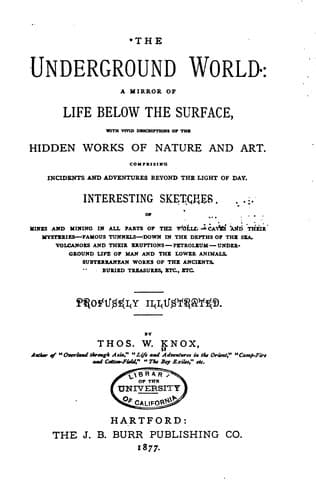
The Underground World: A mirror of life below the surfaceKnox, Thomas Wallace
History
The Underground World: A mirror of life below the surface
Knox, Thomas Wallace
Caves; Mines and mineral resources; Social history -- 19th century; Tunnels
A close-fitting case or coffin was put outside the mummy, and he was
then ready to be packed away for any number of centuries. He kept
well, for the work was thoroughly done; and mummies are constantly
found in good preservation after a rest of four or five thousand
years. The Arabs rob the tombs, and break up the mummies for the gold
and silver which were concealed about them; and many a mummy has
come to grief in consequence of attempting to take his money along
with him. After the mummy is broken up he makes very good fuel; the
Arabs occasionally burn him; and in the early days of the Cairo and
Suez Railway, the firemen on the locomotives found that mummies, cut
into proper lengths, made a very good substitute for wood and coal.
The gums and rags that preserved the mummy are combustible, and thus
facilitate his destruction. Arabs and railway stokers are, like the
law, no respecters of persons, especially if the persons have been
dead forty or fifty centuries. It amuses and benefits these modern
Vandals to burn mummies; and it is proper to say, that the mummies
don’t appear to mind it.
The subterranean tombs and other excavations on the Nile are numerous,
and sometimes of great extent. Several of them are so large, that
travellers who ventured into them without proper guides have been
lost, and have perished for want of food and light. A modern visitor
says that after going through several tombs, he felt very much as if
he had been rolled in an iron mill. The passages leading into the
tombs are long and dark; sometimes they extend hundreds of feet in an
indefinite sort of way, and not by a straight course, as a respectable
tomb ought to have its entrance. A slender man can get along much
more easily than a fat one; the latter gets stuck sometimes, and can
easily fancy himself a number ten gun-wad forced into a number eight
barrel. An acquaintance of mine once vowed that not for the whole of
Egypt would he venture into a tomb again, and that he had done with
explorations.
“Ask him about the tomb of Assasseef at Thebes,” said a mutual
acquaintance, who was sitting between us. We were in a _café_ at Rome,
and whiling away an evening after a visit to the Coliseum, and the
ruins in its vicinity.
“Hang Thebes and all it contains,” was the curt reply. “Well, if you
insist upon it, you shall have it on condition that you won’t speak of
it again.”
We made the required promise; and after taking an extra sip of brandy
and water, he began.
[Sidenote: DAHABIEHS AND DONKEYS.]
Public-domain text, read in full here on John Shaqi.
Reviews
Reviews
No reviews yet
Be the first to share your thoughts on this work.
Elsewhere in the archive
Join the Discussion
Join the discussion
Sign in to leave a comment or review.
Sign InorCreate an account