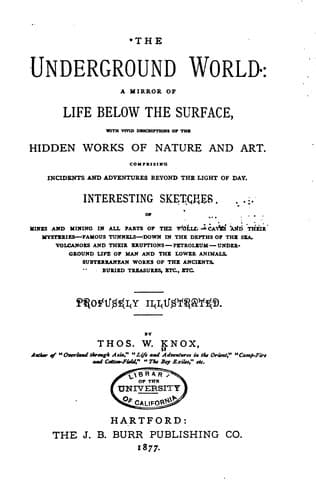
The Underground World: A mirror of life below the surfaceKnox, Thomas Wallace
History
The Underground World: A mirror of life below the surface
Knox, Thomas Wallace
Caves; Mines and mineral resources; Social history -- 19th century; Tunnels
In the apartment known as the King’s Chamber, the walls and roof are
of a highly polished granite, in slabs of great size. The only article
of furniture in it is a sarcophagus of red granite, seven and a half
feet long, three feet wide, and nearly four feet high. It is too large
to be moved through the passage, and must have been placed in the room
before the roof was covered. It is supposed that it contained a wooden
coffin with the mummy of the king, and that these were taken away when
the pyramid was first opened and plundered. In the construction of the
pyramids, arrangements were made for closing the passages with blocks
of granite, which have greatly retarded all attempts at exploration.
It is supposed that there are other apartments yet undiscovered in
the Great Pyramid; and at some future day an enterprising and patient
explorer may be rewarded with important revelations.
Nearly a thousand years ago, the Great Pyramid was visited, and
plundered, and the work of destruction has been renewed at various
intervals since that time. But notwithstanding the centuries that
have passed since the first visit, new apartments and passages have
been discovered within the past thirty years, and several important
facts in the history of the pyramids have been obtained from the
hieroglyphics on the stones of the interior. Another pyramid near the
great one was explored in 1837; a sarcophagus was found, and with
it was a mummy case of King Menkuré, but the mummy was gone where
the woodbine twineth, or somewhere else. Near the pyramids there
is a great number of tombs, some built above the surface, and some
excavated in the rock.
The Arabs have opened nearly all the tombs and plundered them of their
contents. They have no respect for dead Egyptians, and whenever they
find the entrance to a tomb beneath the sands that have been blown
from the desert, they quickly open the receptacle and search it for
articles of value. The Egyptians used to embalm the bodies of their
dead with the greatest care. Professors of the art of embalming were
numerous; and judging by the extent of their work, they must have
been in constant practice. The first step in the Egyptian method was
to put the body in a sort of spicy pickle, where it was kept for two
or three months. The viscera and all internal organs were removed to
give a better chance to the pickle; and when the work was sufficiently
advanced, the body was dried, filled with preserving gums and spices,
and properly bandaged. The bandaging of a mummy was one of the fine
arts, and sometimes a hundred yards of cloth would be required for a
single subject. Every toe and finger had its separate bandage, and the
preserving articles were so soaked into the bandages and plastered
over them, that there was sometimes more gum and bandage than body.
[Sidenote: PREPARING A MUMMY.]
[Sidenote: MUMMIES BURNED FOR FUEL.]
Public-domain text, read in full here on John Shaqi.
Reviews
Reviews
No reviews yet
Be the first to share your thoughts on this work.
Elsewhere in the archive
Join the Discussion
Join the discussion
Sign in to leave a comment or review.
Sign InorCreate an account