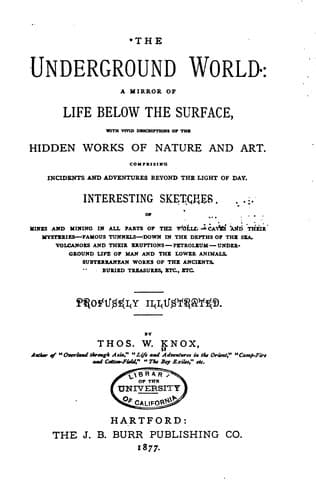
The Underground World: A mirror of life below the surfaceKnox, Thomas Wallace
History
The Underground World: A mirror of life below the surface
Knox, Thomas Wallace
Caves; Mines and mineral resources; Social history -- 19th century; Tunnels
To console himself, he went into a condition of blind drunkenness,
and remained in it till morning. At this camp we cached a couple of
bottles of whiskey, and then solemnly averred, next morning, that
he had swallowed them. To all his denials we were incredulous, and
we narrated, with great minuteness, how he drank one bottle after
another, filling a pint cup at a time, and draining it at a gulp. He
finally began to believe that we were right, and for the rest of the
journey he kept comparatively sober.
[Sidenote: TWO-BOTTLE CAMP.]
On our return, two weeks later, we had a long day’s journey before
us to reach “Two-Bottle Camp,” as we had named it. In the morning we
made a general confession to the old fellow, and owned up to the theft
and concealment of the bottles. His rage at the deception practised
upon him was great, but it was not equal to his joy at knowing there
was happiness ahead. Never on the whole journey did he exert himself
more than on that day to keep the wagon in motion, and enable us to
reach the whiskey-hunting ground by sunset. To him the camp of the Two
Bottles was like a harbor for which the storm-tossed mariner hopes and
prays when the gale is upon him, and his ship is lying at the mercy of
the wind; and as soon as we reached it, he made a rapid break for the
cache, and opened it before the wagon was fairly halted.
He forgave us everything, and for that evening we had a millennium
on a small scale. We compelled him to retain one bottle for the
festivities of the next evening, as we wanted him to go to town sober,
and consequently determined to exhume the keg, and put it in the wagon
without his knowledge. Everything was lovely; the keg was secured,
and when we reached Denver, we pretended to discover it in the office
whence we had started.
In the days of the great emigration overland in 1849 and ‘50, the
emigrants frequently found their wagons too heavily burdened, and were
obliged to throw away or cache a large part of their loads. When they
cached their goods, the Indians generally found them, as the work was
almost always done carelessly and in haste, so that traces of it
could be plainly seen. One old plainsman once described to me a cache
which was made by a party to which he belonged.
“We found,” said he, “that we must lighten up our wagons; and so we
concluded to stop a day or two, make a cache, and give our animals a
chance to rest. We were near the Wind River Mountains, and Indians
were not abundant. We had seen none for several days, and thought we
could rely upon doing our work without their seeing us. We were in
camp when we decided to make the cache, and at daylight next morning
two of us started out to find a good place.
Public-domain text, read in full here on John Shaqi.
Reviews
Reviews
No reviews yet
Be the first to share your thoughts on this work.
Elsewhere in the archive
Join the Discussion
Join the discussion
Sign in to leave a comment or review.
Sign InorCreate an account