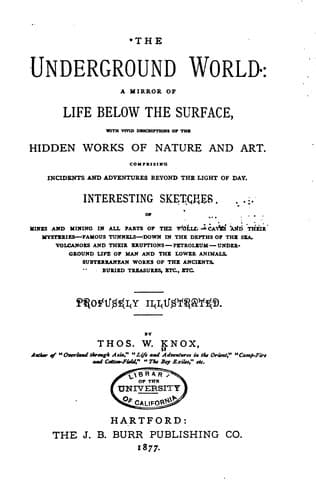
The Underground World: A mirror of life below the surfaceKnox, Thomas Wallace
History
The Underground World: A mirror of life below the surface
Knox, Thomas Wallace
Caves; Mines and mineral resources; Social history -- 19th century; Tunnels
We made a memorandum of the direction, and soon after retired to
sleep. In the morning we broke camp, and continued our journey,
keeping the cache constantly in mind. When we reached the spot
indicated, we opened the grave, and found the sack of flour, as our
friends of a night had told us we should find it. The soil where it
lay was quite dry, and the flour might have been left there for months
without serious injury, beyond growing a little musty.
A grave is regarded with respect by nearly all white men and by
most savages. Consequently a cache is frequently made in the form
of a grave. A head-board bearing the name, residence, and age of a
fictitious dead man, serves to complete the deception, and is likewise
useful in describing the cache so that it can be found. All sorts
of articles can be placed in the grave, provided they are not of a
character to attract wild animals and cause them to dig. In certain
localities, the animals, when hungry, will dig into a real grave, and
exhume the body to devour it. Thus it happens that the fact that a
mound has not been disturbed by beasts sometimes reveals its character
to a keen-eyed observer, and tells him that it is a cache, containing
something else than the remains of a luckless traveller.
[Sidenote: DECEIVING A DRUNKARD.]
In a journey from Denver to New Mexico, in the autumn of 1860, our
party contained one man whose appetite for whiskey was of the keenest
and most insatiable. In making up our outfit, we had left a portion
of the purchases to him, and he had bought about six times as much
fire-water as we really needed. On the first and second day he
managed to get as drunk as a Tammany repeater at election time, and
was neither ornamental nor useful. On the second night, while he was
sleeping, and possibly dreaming of a paradise where there were rivers
of pure Bourbon, and no charge to bathers and drinkers, we arranged a
plan to bring him to grief. We took a keg of whiskey from our wagon,
and cached it a little way from camp. We threw the dirt into the
creek, and built a fire over the place of concealment, so that there
was no trace of what we had done. In the morning we kept him away from
the wagon until we were several miles on the road, and as he had a
bottle at his command he did not discover the loss until night.
But when he did discover it, there was trouble in the camp. We dared
not tell the truth, for fear he would insist upon returning to recover
the treasure. So we feigned ignorance, thought it must have been lost
on the road, or left in Denver, or, possibly, the driver had stolen
it. We were all certain that it had not been left at the camp, as we
had followed the universal custom of emigrants on the plains, and
carefully examined the ground after the wagon had started.
Public-domain text, read in full here on John Shaqi.
Reviews
Reviews
No reviews yet
Be the first to share your thoughts on this work.
Elsewhere in the archive
Join the Discussion
Join the discussion
Sign in to leave a comment or review.
Sign InorCreate an account