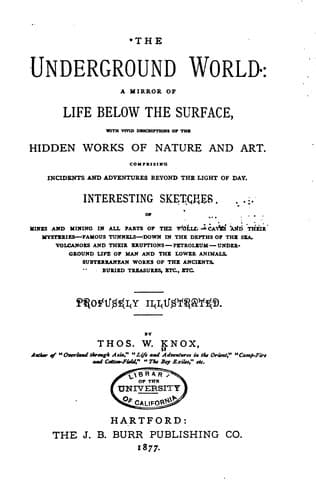
The Underground World: A mirror of life below the surfaceKnox, Thomas Wallace
History
The Underground World: A mirror of life below the surface
Knox, Thomas Wallace
Caves; Mines and mineral resources; Social history -- 19th century; Tunnels
The first apartment is devoted to bronzes of the nicest and most
curious workmanship. There are copies in miniature of some of the
famous statues, that cannot be fully appreciated without close
attention to detail and a liberal understanding of art. A crucifix
by John of Bologna, and a small dog, stretching itself, by Peter
Visscher, are masterpieces of their kind.
In the second apartment are ivory carvings of remarkable excellence;
among them a number of beautiful vases, some quite large, cut out of
a single piece. There are, also, a battle scene by Albrecht Durer,
a crucifix by Michael Angelo, and a marvellous group of some ninety
figures carved in one piece sixteen inches high, representing the fall
of Lucifer and his wicked angels. Nothing could be finer or more exact
than these figures. Small as they are, they are perfect, and plainly
show what extraordinary patience and skill the artist must have had.
A goblet, of stag’s horn, cut like a cameo, in figures portraying the
chase, is admirably wrought, as is also a cup on which the story of
the Foolish Virgins is delineated.
The third apartment has Florentine mosaics, engraved shells, ostrich
eggs carved and ornamented, a singular chimney-piece of Dresden
china set with precious stones, paintings in enamel, and a number of
portraits of historic characters, the most noticeable of which are
Peter the Great and Augustus II., surnamed the Strong.
[Sidenote: CUPS OF GREAT VALUE.]
The fourth apartment is filled with the gold and silver plate formerly
used at the banquets of the Saxon princes, a portion of which was wont
to be carried to Frankfort on the occasion of the coronation of the
German emperors by the electors of Saxony, who held the hereditary
office of arch-marshal at those imposing ceremonies. Beyond the mere
value, this plate is not desirable. If it were mine, I should melt it
at once into the coin of the realm, since it has neither grace nor
beauty of form. It may seem very grand to eat and drink out of such
vessels, but they would be found extremely inconvenient for practical
purposes. The china of our day is altogether superior to all the gold
and silver plate that has ever been heaped on royal tables.
The fifth apartment is taken up with agates, crystals, chalcedony,
lapis lazuli, and other varieties of semi-precious stones. Some cups
of moss agates are particularly beautiful, and two goblets, composed
entirely of cut gems, have a value of ten thousand dollars each. An
equestrian statue of Charles II. of England, made from a solid piece
of cast iron, represents him in the character of St. George, and is
skilfully done. The eminent sculptor, Colin of Mechlin, has shown the
cunning of his art by two spirited combats of knights, though they are
only wooden heads; wood being the material of which the carvings are
made. The largest enamel painting known, a Magdalen by Dinglinger, is
also shown there.
Public-domain text, read in full here on John Shaqi.
Reviews
Reviews
No reviews yet
Be the first to share your thoughts on this work.
Elsewhere in the archive
Join the Discussion
Join the discussion
Sign in to leave a comment or review.
Sign InorCreate an account