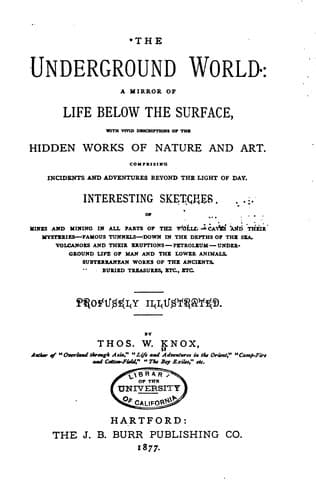
The Underground World: A mirror of life below the surfaceKnox, Thomas Wallace
History
The Underground World: A mirror of life below the surface
Knox, Thomas Wallace
Caves; Mines and mineral resources; Social history -- 19th century; Tunnels
The sixth apartment abounds in figures carved in ivory and wood,
many of them caricatures of men and animals, which express the
grotesqueness of the German mind. Single pearls of extraordinary
size, nearly all found in the River Elster, are cut into odd shapes,
some of them representing rustics, jesters, and elves. A pearl, large
as a hen’s egg, is intended to portray a Spanish court dwarf, and
is superbly done. Trinket as it is, it could not be purchased for
twenty-five thousand dollars. There is, besides, any number of costly
trifles, on which a vast deal of ingenuity and money must have been
expended, and which are interesting from their artistic merit.
The seventh apartment is radiant with the splendid regalia used at the
coronation of Augustus II.
Augustus is inseparably associated with the history of Saxony, and the
antecedents of Dresden. He succeeded his father, John George III.,
as Elector of Saxony, though not until after his elder brother’s
death, in 1694, and was elected to the throne of Poland, made vacant,
two years later, by the decease of John Sobieski. The Polish nobles
were unwilling to be ruled over by anybody but a Roman Catholic,
and Augustus, whose theology was of a very accommodating quality,
abandoned Protestantism for the sake of the crown.
Between his wars, his intrigues, and his parades, his sixty-three
years of life were superlatively busy. He was highly educated for his
time, and so much interested in art that he began the collection of
pictures in the Dresden Gallery, and purchased many of the valuable
curiosities now in the Green Vaults. His reign was marked by luxury
and splendor, and his court was the constant resort of artists,
alchemists, and adventurers of both sexes, on whom he lavished
countless favors. The celebrated Countess of Königsmark was one of
his many mistresses, and bore him a son, who subsequently figured so
prominently in French history as Maurice, Count de Saxe.
[Sidenote: ROMANTIC STORIES OF A KING.]
Augustus was such a prodigal that he loaded Saxony with debt, and
inspired the magnates of Poland to imitate his improvident example in
Warsaw. Elegant, accomplished, daring, and unscrupulous, he made war
on men and love to women to the end of his days. If all the accounts
be true, he was as charming as Apollo and as strong as Hercules. The
archives of Dresden attest his wonderful muscle to such a degree
that Samson would have been no match for him. One of his pastimes was
to become enamoured of some distinguished lady he had never seen; go
in search of her; throw her husband, father, or brother, just as it
happened, over high walls, and then carry her off in his arms as if
she had been a feather weight.
Public-domain text, read in full here on John Shaqi.
Reviews
Reviews
No reviews yet
Be the first to share your thoughts on this work.
Elsewhere in the archive
Join the Discussion
Join the discussion
Sign in to leave a comment or review.
Sign InorCreate an account