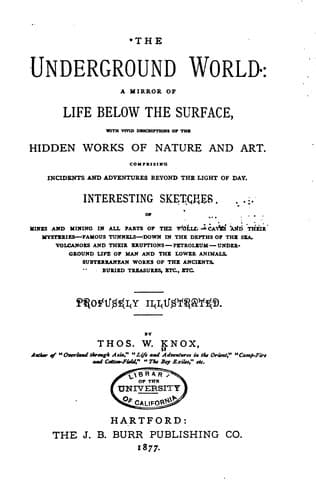
The Underground World: A mirror of life below the surfaceKnox, Thomas Wallace
History
The Underground World: A mirror of life below the surface
Knox, Thomas Wallace
Caves; Mines and mineral resources; Social history -- 19th century; Tunnels
These tales are interesting, but there are too many of them to be
credible. I cannot tell how large the Saxon or Polish women were a
century and a half ago, but I will lay a large wager that Augustus
could not carry very far many of them I have seen recently. If he had
the taste ascribed to him, I am sure he would not make the attempt,
unless it should happen to be in the night, when darkness reduces
beauties and beldames to the same level.
[Sidenote: ROYAL PASTIMES.]
Persons going to Dresden, or indeed to any part of Saxony, will spare
themselves questions by presuming that Augustus has done nearly
everything worth doing in the entire kingdom. He is to Saxony what St.
Patrick is to the south of Ireland, King David to Scotland, or Charles
V. to Belgium.
The eighth and last apartment entirely eclipses all the others in the
richness and magnificence of its contents. One of the wonders of this
cabinet, called the Court of the Great Mogul, was made by Dinglinger,
an artist justly considered the Benvenuto Cellini of Saxony. The
Court represents the Emperor Aurengzebe on his throne, surrounded by
courtiers and soldiers,—about one hundred and forty figures,—in pure
gold enamelled, attired in costumes appropriate to the country and the
time. Each figure has its individual expression and character, as will
be perceived by close observation.
This marvellous toy, which is really a work of the highest art,
employed Dinglinger (he was the court jeweller during the early part
of the eighteenth century) for nearly ten years, and cost one hundred
thousand dollars. Another carving of a similar character portrays
different artisans with a fineness and finish which no one would
expect, considering its diminutive proportions. There are also other
specimens of his exceeding skill that fully entitle him to the fame
he has achieved.
A specimen of uncut Peruvian emeralds, bestowed by the Emperor Charles
V. on the Elector of Saxony, is one of the finest in the world, and a
mass of solid native silver from the Himmelfüst mine of Freiberg so
well illustrates its richness as to enable me to believe that in fifty
years nearly twenty-two hundred tons of silver were obtained from that
single mine.
The Saxon regalia there exhibited includes the sword of the elector,
carried by the princes at the imperial coronations; the decorations of
a miner’s uniform made for the Elector John George; a great number of
chains, collars, and orders of the Garter, Golden Fleece, and Polish
Eagle; and a curious antique portrait (a cameo of onyx) of Augustus
the Strong. A sardonyx six and a half inches long, and four and a half
broad, reputed to be the largest extant, attracts much attention from
its oval shape and beautiful regularity.
Public-domain text, read in full here on John Shaqi.
Reviews
Reviews
No reviews yet
Be the first to share your thoughts on this work.
Elsewhere in the archive
Join the Discussion
Join the discussion
Sign in to leave a comment or review.
Sign InorCreate an account