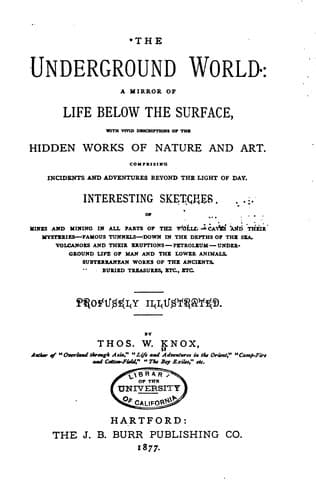
The Underground World: A mirror of life below the surfaceKnox, Thomas Wallace
History
The Underground World: A mirror of life below the surface
Knox, Thomas Wallace
Caves; Mines and mineral resources; Social history -- 19th century; Tunnels
We had provided ourselves with wax tapers, which we lighted, each
of us carrying one, before we went down a circular flight of some
one hundred steps leading to the dismal galleries running in every
direction, and containing the ghastly remains of millions of our
fellow-creatures, once as merry and ambitious, as fond and foolish,
as hopeful and as vain, as any of us are to-day. At the bottom of the
staircase a guide placed himself at our head, and, observing that our
tapers were all in good order, took the lead, after exhorting us to
keep together, and on no account, if we valued our lives, to attempt
to explore any other than the main avenues through which we were to
pass.
The Catacombs hold the victims of the different revolutions so
frequent in Paris; and now, moreover, the common graves (_les fosses
communes_) in the three principal cemeteries of Montmartre, Mont
Parnasse and Père la Chaise, are emptied every five years, and the
plebeian relics consigned to the Catacombs, to make room for more
bodies in those populous burying-grounds. Thus are the great vaults
steadily and rapidly increasing their lifeless hosts, and adding to
the horrors of a region necessarily horrible from the first.
[Sidenote: THE FIRST OF THE PASSAGES.]
[Sidenote: YAWNING PITS AND CAVERNS.]
Several hundred yards from the base of the steps which we had
descended is an octagonal vestibule, and over it an inscription in
Latin to this effect: “Beyond these boundaries repose those who await
a blessed immortality.” We passed through a door leading into a long
gallery lined with bones from the floor to the roof; the arm, leg, and
thigh-bones being closely and regularly piled together in front, their
uniformity relieved by three rows of skulls at equal distances, while
behind these the smaller bones are thrown, regardless of arrangement
of any kind. The gallery conducts to several apartments resembling
chapels, called Tombs of the Revolutions, and Tombs of the Victims,
because they hold the relics of those who had perished in popular
insurrections against existing authority. I had noticed, before
reaching the vestibule, and what may be considered the Catacombs
proper, that the passage was very narrow,—only two persons being able
to walk abreast therein,—and little more than six feet in height. This
passage soon made a sharp turn, and at the corner the names of the
streets directly above were cut into the stone, and two black arrows
painted upon it, one pointing to the entrance of the vaults, and the
other to the great charnel-house we were about to explore. We were in
chambers of hewn-out rock. Rock was above us, below us, and on every
side. The walls were very damp, the water in many places dripping
through what might be termed the ceiling, in which were so many cracks
and crevices that it seemed as if the walls might tumble and bury
us at any moment. Two or three of my companions grew very nervous
as they perceived about them such alarming signs of insecurity, and
Public-domain text, read in full here on John Shaqi.
Reviews
Reviews
No reviews yet
Be the first to share your thoughts on this work.
Elsewhere in the archive
Join the Discussion
Join the discussion
Sign in to leave a comment or review.
Sign InorCreate an account