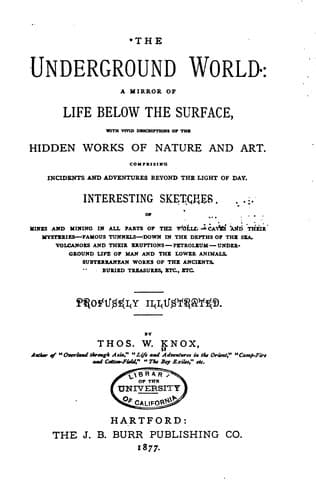
The Underground World: A mirror of life below the surfaceKnox, Thomas Wallace
History
The Underground World: A mirror of life below the surface
Knox, Thomas Wallace
Caves; Mines and mineral resources; Social history -- 19th century; Tunnels
A native of Maine entertained us by inquiring constantly of the guide,
who could not speak a word of English, while the New Englander had
not the least knowledge of French, in regard to the probable cost of
the Catacombs, and whether they paid as an investment. He was very
desirous to know, also, whose skull this one might be, and whose that,
evidently under the impression that all the monarchs and historic
characters of France were buried there. Our guide, too polite not
to pretend to comprehend the inquisitive fellow, gabbled away in
bewildering generalities. The Maine man asseverated again and again,
that he would give five dollars to know what the Frenchman said; and
therefore I assumed to tell him. I informed him, though the Catacombs
had cost five hundred millions of dollars, that they paid a larger
interest than any property in the country; that they were owned by the
Rothschilds, who received one hundred dollars from the government for
every skull put into the vaults; and that, as there were six millions
of them, he could calculate the profits. “By thunder!” he replied; “no
wonder those old Jews are so rich. I never knew before how they made
all their money. I wonder if a chap couldn’t buy a little Catacomb
stock.”
That mighty charnel-house is not without its tragic history. A number
of persons have been lost there in spite of all the precautions
against accidents; but these have been very rare of late, because so
few persons could obtain admission.
A few years ago, a newly-married couple arrived in Paris from the
provinces, having gone to the city on their bridal tour. It was their
first visit to the capital, and they were naturally desirous to see
its lions. The bride had heard a great deal of the Catacombs, and
would not be satisfied without exploring them, albeit her husband
endeavored to dissuade her from such a dismal enterprise. She was
bent on going, and so they went together. He kept close to her side,
constantly fearing she might be lost. He admitted that he had a
presentiment respecting her, and sure enough it was realized.
[Sidenote: AN UNHAPPY HONEYMOON.]
Public-domain text, read in full here on John Shaqi.
Reviews
Reviews
No reviews yet
Be the first to share your thoughts on this work.
Elsewhere in the archive
Join the Discussion
Join the discussion
Sign in to leave a comment or review.
Sign InorCreate an account