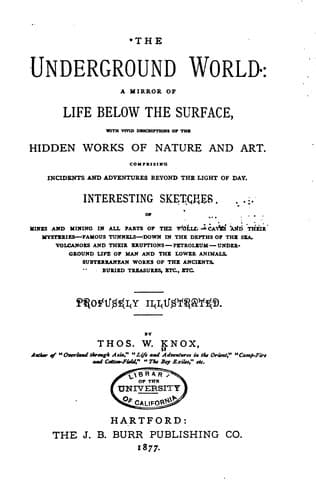
The Underground World: A mirror of life below the surfaceKnox, Thomas Wallace
History
The Underground World: A mirror of life below the surface
Knox, Thomas Wallace
Caves; Mines and mineral resources; Social history -- 19th century; Tunnels
They had been in the Catacombs something more than an hour, when,
having stopped to examine a curious skull, he called for her to look
at it, and discovered, to his horror, that she was missing. There
were nearly two hundred in the party, and nobody had observed when
or where she had disappeared. They all retraced their steps, entered
the adjoining passages, and shouted themselves hoarse to attract her
attention; but all in vain. Not the least vestige of her could be
discovered. The bridegroom was beside himself with grief, declaring
that he knew she would never be found, and calling upon the rocks to
fall, and relieve him of his misery. It became necessary to drag him
from the sepulchral vault, and when this was done, he proved to be a
raving maniac. He was sent to an asylum, where such was the violence
of his paroxysms night and day, that he died of exhaustion in less
than a fortnight. Diligent search was made for the missing bride,
though to no purpose. Not the slightest clew was obtained to her
fate, and it was finally conjectured that she must have wandered into
some tortuous avenue, and fallen into one of the pits which I have
described. Such was the melancholy ending of a honeymoon before it had
fairly begun.
Another couple, who had been married a number of years, and who had
long lived so inharmoniously that they had gone apart several times,
entered the Catacombs in the spring of 1853. The wife was missing when
the party came out,—it is always the custom to count the number at the
beginning and end of the journey, so as to see that none are lost,—and
the husband asserted that he had seen her only a few seconds before.
Still, she could not be found on that day or the next; but about a
fortnight after, a body answering to her description was discovered in
one of the narrow passages into which excursionists are never taken.
She had evidently been dead some time, and a deep wound on her temple
indicated that she might have perished from violence. Her husband was
not free from suspicion of having murdered her; but as she might have
been so injured by a fall, he was never openly accused of the crime.
The story was generally circulated, and the anti-matrimonial jesters
of the capital insinuated that more than a thousand unhappy husbands
immediately applied for permission to make the subterranean tour
with their wives, in the hope that they might be as fortunate as the
ungrieving widower.
[Sidenote: IMPRISONED FOR THREE HOURS.]
Public-domain text, read in full here on John Shaqi.
Reviews
Reviews
No reviews yet
Be the first to share your thoughts on this work.
Elsewhere in the archive
Join the Discussion
Join the discussion
Sign in to leave a comment or review.
Sign InorCreate an account