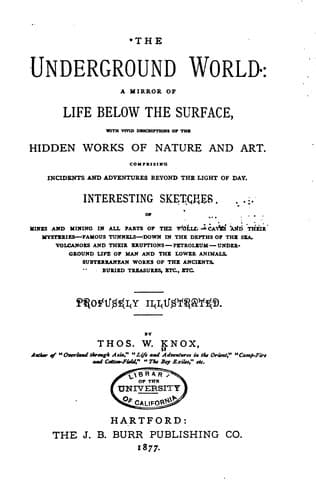
The Underground World: A mirror of life below the surfaceKnox, Thomas Wallace
History
The Underground World: A mirror of life below the surface
Knox, Thomas Wallace
Caves; Mines and mineral resources; Social history -- 19th century; Tunnels
In various parts of the world there are springs, or natural sources,
of inflammable oil. Some of these have been known for thousands
of years, but most of them are of recent discovery. The oil which
flows from these springs is generally known as “petroleum,” the word
being of Latin origin, and signifying rock oil. The most productive
oil springs are of artificial origin, and are made by boring into
the earth, or rock, in certain localities. The most famous natural
deposit of this substance, or anything akin to it, on the surface of
the earth, is in the Island of Trinidad, in the West Indies, where it
forms a lake of asphaltum and petroleum, which is called Tar Lake.
This material is a very good substitute for pitch, and is extensively
used for coating vessels, and preserving their timber.
A gentleman who has visited this lake says that it is about a mile
from the sea-shore, and the distance around it is about a mile and
a half. Near the shore the tar is solid, and appears as if it had
cooled, when the liquid was boiling, in large bubbles. As one goes
from the shore to the middle of the lake, the temperature increases,
the matter becomes softer, and in the centre it boils steadily. At a
distance, when first seen, it resembles a lake of water; but when one
approaches it, it appears like glass. A strong odor of sulphur arises
from it, and can be detected at a distance of eight or ten miles.
There is a bed of coal under the lake. It is of bituminous character,
and makes a thick smoke when burning.
[Sidenote: THE SACRED FIRE WELLS.]
The largest supplies of petroleum are obtained in America. Throughout
Europe and Asia there are many petroleum wells. One of the most
celebrated localities where they are found is the eastern shore of
the Caspian Sea. At Baku, on the shores of the Caspian, there are
many springs of naphtha and petroleum, and a great many streams of
inflammable gases. The abundance of these wells caused the region to
be called The Field of Fire; and in the ancient times Baku was known
as the Sacred City of the Fire Worshippers. The annual value of this
production is about half a million of dollars. About fifteen miles
from Baku there is a jet of inflammable gas rising from the rock, and
known as the Perpetual Fire. A temple has been built over it, and the
fire has been burning for hundreds of years. Pilgrims come from all
parts of Asia to visit this sacred well. The place is in charge of a
large priesthood, who are supported by the gifts of the devotees.
Another region, quite as wonderful as that of Baku, is the Rangoon
district, in India; and a considerable portion of India has been,
for thousands of years, supplied by it with rock oil. One authority
says, that the number of wells in that district is nearly six hundred,
yielding half a million hogsheads of oil annually. Most of the Rangoon
wells are artificial, and are sunk in beds of sandy clay, resting on
the sandstone, but the wells rarely exceed a hundred feet in depth.
Public-domain text, read in full here on John Shaqi.
Reviews
Reviews
No reviews yet
Be the first to share your thoughts on this work.
Elsewhere in the archive
Join the Discussion
Join the discussion
Sign in to leave a comment or review.
Sign InorCreate an account