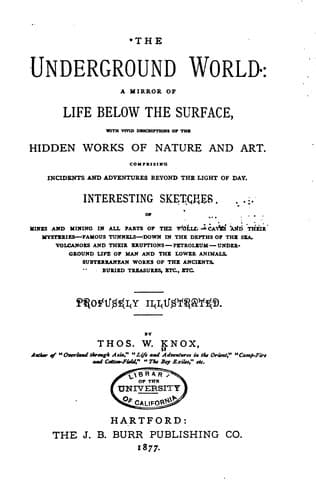
The Underground World: A mirror of life below the surfaceKnox, Thomas Wallace
History
The Underground World: A mirror of life below the surface
Knox, Thomas Wallace
Caves; Mines and mineral resources; Social history -- 19th century; Tunnels
Some parts of Africa are known to contain petroleum springs, and there
are many of these springs throughout China and various other regions
of the East; Australia and New Zealand claim their share, and it is
probable that every country on the globe could, by means of proper
borings, be made to yield petroleum.
[Sidenote: SENECA OIL AS A MEDICINE.]
As before stated, America is the great petroleum-producing country
of the world. Rock oil is found in various parts of the American
continent, from Hudson’s Bay to the Gulf of Mexico, and from the
Atlantic to the Pacific Ocean. The most prolific oil region in
America is in Western Pennsylvania, and millions of dollars’ worth
of petroleum have been obtained there. Thousands of men have made
fortunes in petroleum, and a great many have made fortunes in it the
wrong way. The early settlers of that region were well aware of the
existence of petroleum, having obtained their knowledge of it from
the Indians. The Indians used to collect the oil on the shore of
Seneca Lake, and it was sold as a medicine, in small quantities, under
the name of Seneca Oil. A stream in Alleghany County, New York, was
named Oil Creek, on account of the petroleum floating on its surface,
and the same name was given to another stream in Venango County,
Pennsylvania. On the old maps of that region several localities were
marked as affording oil, but it is only within the past thirty years
that the oil product has been of any importance.
The substance, as before stated, was used as a medicine, and the
inhabitants collected it by spreading blankets on the surface of the
stream, and then wringing out the oil which they absorbed. There are
indications that the oils were collected long ago, as several deep
and very old pits have been discovered. Some people attribute the
construction of these pits to the early French settlers, some to the
Indians, and some to the predecessors of the Indians. A history of
Pennsylvania, published thirty years ago, says that the Indians used
the oil to mix with paint in dressing themselves, and refers to an old
letter, written by the commander of Fort Duquesne to General Montcalm,
describing an assembly of Indians at night on the banks of the creek;
and in the midst of their ceremonies they set fire to the oil on the
surface of the water. As the flames burst out, the Indians gave wild
shouts, which recalled to the writer many of the ceremonies of the
ancient fire worshippers at Baku.
[Sidenote: BORING FOR SALT WATER.]
Public-domain text, read in full here on John Shaqi.
Reviews
Reviews
No reviews yet
Be the first to share your thoughts on this work.
Elsewhere in the archive
Join the Discussion
Join the discussion
Sign in to leave a comment or review.
Sign InorCreate an account