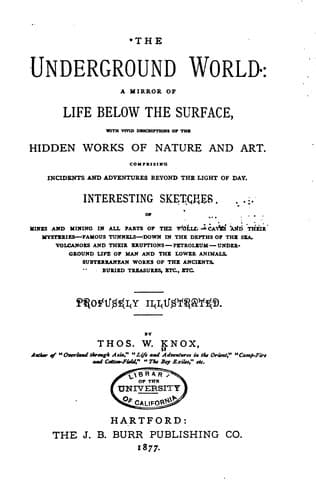
The Underground World: A mirror of life below the surfaceKnox, Thomas Wallace
History
The Underground World: A mirror of life below the surface
Knox, Thomas Wallace
Caves; Mines and mineral resources; Social history -- 19th century; Tunnels
The early settlers did not collect great quantities of oil, probably
not more than twenty-five or thirty barrels a year. In 1845 operations
were being conducted for obtaining salt at a place above Pittsburg,
on the Alleghany River. Several springs of petroleum were struck, but
the value of the material was not known. In Ohio, over fifty years
ago, borings were made for salt water. An account, descriptive of the
work, said, “They have sunk two wells, which are now more than four
hundred feet deep. One of them affords very strong and pure water, but
not in great quantity. The other discharges such vast quantities of
petroleum, or, as it is vulgarly called, Seneca oil, and besides is
subject to such tremendous explosions of gas, as to force out all the
water, and afford nothing but gas for several days. We make but little
or no salt.”
This story of the ignorance of the value of petroleum and the
disappointment of the salt-makers at finding springs of petroleum
instead of salt water, reminds one of the account of the Irishman who
complained of his trouble in shooting ducks: “I was not able to fire a
shot,” said he. “Every time I got sight of a duck another one swam in
between him and me, and I could not kill anything.”
[Illustration: PUMPING WELL ON OIL CREEK, VENANGO COUNTY,
PENNSYLVANIA.]
The first movement for utilizing this vast oil product was made, in
1854, by two New Yorkers, who organized a company, and secured the
right to a certain spring on Oil Creek; but they made no progress
until three years later, when Messrs. Bowditch and Drake, of New
Haven, undertook to search for oil. In the winter of 1858 and ‘9,
Colonel E. S. Drake completed arrangements for boring into the rock
below the bed of the creek. On the 26th of August, 1859, oil was
found at a depth of seventy-one feet. The drills sank into a cavity
in the rock, and the oil rose to the surface. By means of a pump,
four hundred gallons were obtained per day, and a larger pump being
introduced, the supply reached one thousand gallons daily. This was
the beginning of the borings for oil in that region. Every spot where
oil was found, or was likely to be found, was carefully examined,
and a great many wells were put down. Up and down the banks of Oil
Creek derricks were erected and wells were sunk, and in a year or two
the banks of the stream looked as if their natural product had been
derricks rather than trees. The ground was perforated like a sieve,
and if the holes had been a few feet, instead of a few inches, in
diameter, it would have been dangerous walking round there for fear
of tumbling through. The original depth of seventy-one feet was found
insufficient, and the borings were frequently conducted to a depth of
several hundred feet. I believe one well was sunk over two thousand
feet, and a great many wells exceeded a thousand. Many of them never
produced oil, and the man who had risked his money to bore these wells
saw it vanish without affording anything in return.
Public-domain text, read in full here on John Shaqi.
Reviews
Reviews
No reviews yet
Be the first to share your thoughts on this work.
Elsewhere in the archive
Join the Discussion
Join the discussion
Sign in to leave a comment or review.
Sign InorCreate an account