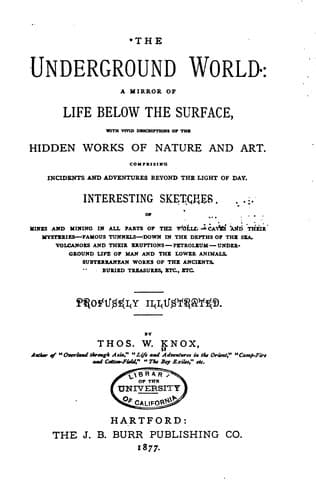
The Underground World: A mirror of life below the surfaceKnox, Thomas Wallace
History
The Underground World: A mirror of life below the surface
Knox, Thomas Wallace
Caves; Mines and mineral resources; Social history -- 19th century; Tunnels
“Then we stopped a well-dressed Frenchman, and said to him,
‘_Monsieur, où est la Bastille?_’ The fellow was too polite to laugh
in our faces, as the conductor did, but he said not a word, and walked
off. I saw, though, when his back was turned towards us, that he was
shaking his sides, and evidently grinning.
“Then we stepped into the restaurant, and I said to a waiter,
‘_Garçon, où est la Bastille?_’ and that infernal waiter laughed in
my face. I said to the other boys, ‘These confounded Frenchmen round
the Bastille are all fools. I thought Frenchmen were polite, but these
fellows have no politeness at all.’ We climbed out of that restaurant,
and went out on the square on a Bastille hunt.
“There was no more sign of a prison than there is inside your boot. We
walked round that square about ten minutes, when it got into one of
our heads,—not into mine though,—that the Bastille had been destroyed
in 1789. I had nothing more to say, except that we were the three
biggest fools in all Paris. Here we had been hunting round, boring
everybody, and asking them to show us a prison which was destroyed
eighty years before, as we perfectly well knew, only we did not happen
to recollect it. We went back to the Grand Hotel, and the next time we
went out sight-seeing we made sure that the thing we inquired for was
in existence.”
[Sidenote: DESCRIPTION OF THE BASTILLE.]
The Bastille was an irregular building in shape, as the original
construction, in the time of Charles V. had been added to by each
successive monarch. It had as its principal feature eight round
towers, connected by curtains of masonry, and was encircled by a ditch
a hundred and twenty-five feet wide. This ditch was generally dry, and
was surrounded on its outside by a wall sixty feet high, to which was
attached a wooden gallery running round the whole inner circumference
of the ditch opposite the castle. This gallery was called the
“Rounds.” Sentinels were stationed on these Rounds, and it was their
duty to be perpetually in motion, in order to discover any movement of
the prisoners for escaping. The Bastille had a governor and a staff
of assistants, and it had a garrison of one hundred men, with their
proper officers.
Whenever a prisoner was brought to the Bastille, his trunks and
clothing were carefully examined, in order to discover whether he had
any concealed papers or weapons. The advocate Linguet, who had been
detained there for three years, says,—
Public-domain text, read in full here on John Shaqi.
Reviews
Reviews
No reviews yet
Be the first to share your thoughts on this work.
Elsewhere in the archive
Join the Discussion
Join the discussion
Sign in to leave a comment or review.
Sign InorCreate an account