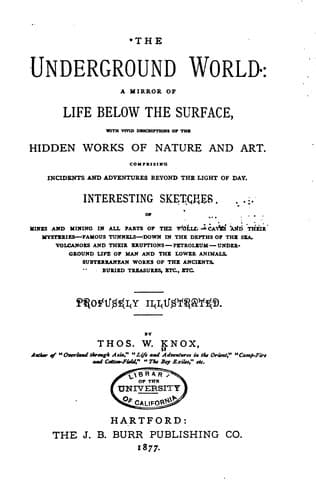
The Underground World: A mirror of life below the surfaceKnox, Thomas Wallace
History
The Underground World: A mirror of life below the surface
Knox, Thomas Wallace
Caves; Mines and mineral resources; Social history -- 19th century; Tunnels
“The new comer is as much surprised as alarmed to find himself
subjected to a personal examination by four men, whose appearance
seems to belie their functions; men clad in uniforms, which leads
one to look for a regard to decencies, and wearing decorations which
presuppose a service which endures no stain. This man takes from him
his money, that he may have no means of corrupting any one of their
number, his jewelry on the same consideration, his papers for fear he
should find any resource against the tedium to which he is henceforth
devoted, and his knives and scissors are taken from him for fear he
should commit suicide or assassinate his jailers.”
After this examination he was led to the cell intended for him to
occupy. These cells were situated in all the towers. The walls were at
least twelve feet in thickness at the top, and at the base they were
thirty or forty feet. Each cell had a small window defended by three
iron gratings, one within, the second without, and the third in the
middle thickness of the masonry.
The bars of this grating were an inch thick. No fire was allowed, and
there was no glass in the windows, so that in winter these cells were
like ice-houses, and in summer they were hot and damp.
[Sidenote: CHARACTER OF THE DUNGEONS.]
The dungeons were nineteen feet below the level of the court-yard,
and five below that of the ditch. They had no openings but a narrow
loophole communicating with the ditch. The inhabitant of these
dungeons was deprived of air and daylight, and lived in a damp and
infected atmosphere. Oftentimes the floor of his cell was covered with
mud, and he found himself surrounded by reptiles, rats, and other
disagreeable creeping or walking things.
The written history of the Bastille shows that these horrible cells
were frequently used for the confinement of prisoners in order to make
their existence as terrible as possible. There is a tradition that
iron cages were used for the confinement of prisoners, but writers who
have given their attention to this subject say that nothing of the
sort was discovered at the time the Bastille was destroyed. There is
also a tradition in regard to the _Oubliettes_, which are described as
holes into which condemned prisoners were lowered, where they should
languish and die forgotten. There is also a tradition in regard to a
Question Chamber, in which suspected prisoners were tortured to make
them confess their guilt, or to reveal the names of their accomplices.
[Illustration: PLACE DE LA BASTILLE, PARIS.]
[Illustration: THE BASTILLE.—ERECTED IN 1369.]
Public-domain text, read in full here on John Shaqi.
Reviews
Reviews
No reviews yet
Be the first to share your thoughts on this work.
Elsewhere in the archive
Join the Discussion
Join the discussion
Sign in to leave a comment or review.
Sign InorCreate an account