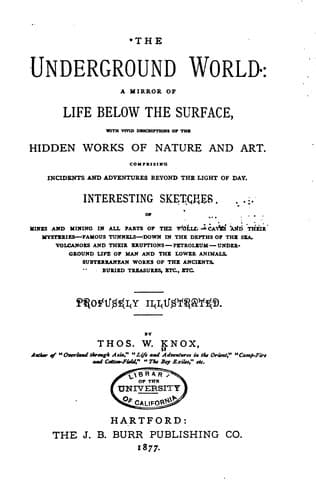
The Underground World: A mirror of life below the surfaceKnox, Thomas Wallace
History
The Underground World: A mirror of life below the surface
Knox, Thomas Wallace
Caves; Mines and mineral resources; Social history -- 19th century; Tunnels
Sometimes the Bastille was under governors who had a good deal of the
milk of human kindness in their composition, and sometimes it was
under the control of men who had as little feeling and sympathy as a
stone. Prisoners were well or badly treated according as the governor
was good or bad in character, and also according to the instructions
which had been received concerning their treatment. The most horrible
feature about the Bastille was the mode of sending persons to it. No
man could be safe from imprisonment there, and he was subject to the
whims and caprices of the minister of state, whom no appeals could
reach, and by whom no call for justice would be heard or heeded. If
any man incurred the displeasure of the minister, or of any one who
had sufficient influence to secure an order for his arrest under the
royal seal, he might be taken to the Bastille at any moment. If his
accuser desired that he should never more go out into the world, and
never hold communication with any one, the accuser’s will became law.
Hundreds of men were sent to the Bastille without knowing the cause of
their arrest or the names of their accusers, and without being allowed
to communicate with family or friend. It was this uncertainty, this
ever-present fear of injustice and cruelty, that made the name of the
Bastille appalling, and led every Frenchman to regard it as a place
full of horrors.
[Sidenote: HORRORS OF THE BASTILLE.]
It is said that some of the most barbarous cruelties ever inflicted
within the walls of the Bastille were during the reign of Louis
XI. Louis himself was the author and inventor of some of the worst
barbarities. It is recorded in history, that he caused dungeons to
be made in the Bastille surrounded with smooth and polished masonry,
where the prisoners, who were lowered into them, were obliged to
remain in an unnatural position, which they could not change.
According to history, the princes of the house of Armagnac were shut
up in these horrible pits, and were drawn out twice a week to be
scourged in the presence of the governor, and once in every three
months to have two of their teeth torn from their jaws. Sometimes
split sticks of dry wood were placed on their fingers, and then the
sticks would be set on fire and allowed to consume. Richelieu sent
many of his enemies to the Bastille, some of whom were treated with
extreme consideration, while others endured great severity. One of
these men, the notorious Bassompierre, was immured there twelve years
by the order of Richelieu.
[Sidenote: MAN IN THE IRON MASK.]
Public-domain text, read in full here on John Shaqi.
Reviews
Reviews
No reviews yet
Be the first to share your thoughts on this work.
Elsewhere in the archive
Join the Discussion
Join the discussion
Sign in to leave a comment or review.
Sign InorCreate an account