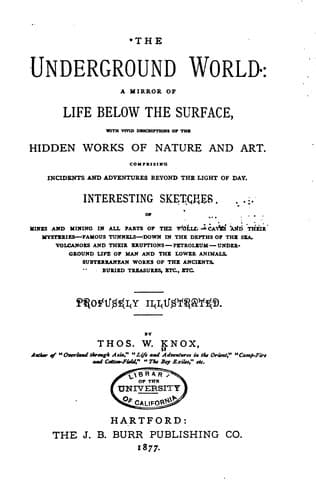
The Underground World: A mirror of life below the surfaceKnox, Thomas Wallace
History
The Underground World: A mirror of life below the surface
Knox, Thomas Wallace
Caves; Mines and mineral resources; Social history -- 19th century; Tunnels
The Bastille could contain fifty state prisoners in solitary cells,
and by putting two persons in one cell the number could be raised
to a hundred. Sometimes as many as three hundred persons were in
the Bastille at once, and in that case they were densely crowded.
According to history the prisoners were wretchedly fed, but it should
be said, in justice to the government, that this state of affairs
was probably due to the frauds of the subordinates rather than to
any intended cruelty on the part of the government, as the latter
generally made liberal allowances for the support of the prisoners
of state. One writer asserts that in his time the governor of the
Bastille had a great number of prisoners, many of whom were paid
for at twenty-five francs a day, and that their subsistence did
not cost as many sous. There was a regular tariff for expenses for
the table, lights, and washing of all prisoners, according to their
rank. A prince was allowed fifty francs a day, a marshal of France
thirty-six francs, a lieutenant general thirty-four francs, and so on
down to the inferior prisoners, who were allowed two francs and a half.
[Sidenote: TREATMENT OF PRISONERS.]
A prisoner might be examined at the moment of his arrest, or not
until weeks, months, or years afterwards. He had no mode of offering
any defence, or of telling his friends where he was, or why he was
detained; and sometimes he did not himself know these facts. He was
allowed no books or papers; he could not communicate with anybody
except by special permission. He could not be visited except on an
order from the lieutenant of police, and at such visits all the
conversation must be in the presence of an officer of the prison,
and no allusion could be made to the cause of detention, the term of
imprisonment, or any topic of that sort.
The treatment of prisoners varied greatly. Some, whom it was desired
to kill by slow torture, without trial, or even without a hearing,
were shut up in the horrible dungeons already described, where they
were fed on the worst possible food until death relieved them from
their suffering. Others, whom it was not designed to punish or
destroy, but simply to detain, enjoyed every comfort, and a great
deal of luxury. They had large rooms, fine furniture, excellent and
abundant food, plenty of wine, books, and papers, could have their
own servants, could be visited by their friends or families; in fact,
could do pretty nearly as they pleased, except to go out of the
Bastille.
Public-domain text, read in full here on John Shaqi.
Reviews
Reviews
No reviews yet
Be the first to share your thoughts on this work.
Elsewhere in the archive
Join the Discussion
Join the discussion
Sign in to leave a comment or review.
Sign InorCreate an account