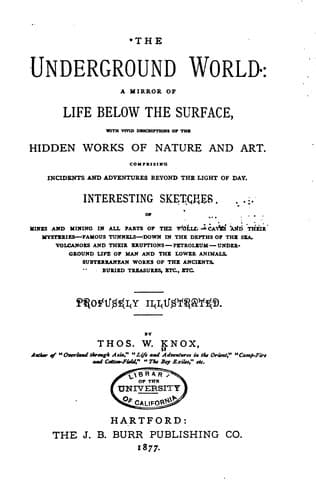
The Underground World: A mirror of life below the surfaceKnox, Thomas Wallace
History
The Underground World: A mirror of life below the surface
Knox, Thomas Wallace
Caves; Mines and mineral resources; Social history -- 19th century; Tunnels
In the Bastille he was waited upon at the table and at his toilet
by the governor, and no one else. He was allowed to go to mass,
and a file of soldiers always accompanied him. Their muskets were
loaded, and their matches were lighted; they were ordered to kill him
instantly in case he spoke to any one, or attempted to tear off his
mask. Who he was, and what he was, will probably never be known. No
person of sufficient note to justify such precautions as were taken
in his case was absent from the stage of history at that time. The
general impression is, that he was an elder brother of Louis XIV.,
the fruit of an adulterous intrigue between Anne of Austria and the
Duke of Buckingham, or some other of those lovers for which Anne was
famous. As he was born in wedlock, he could not have been dispossessed
of his claim to the throne, if his existence had been admitted. Louis
XIV. may have had some absurd prejudice against murdering his brother,
though it was not the fashion of those days to be so very fastidious.
A story was written by Dumas under the title of the Man in the Iron
Mask, and it has been dramatized and given on the stage in Europe and
America. The mystery which envelops the wearer of the mask gives an
additional interest to all stories concerning him.
[Sidenote: DESTRUCTION OF THE BASTILLE.]
In talking about this historic individual, we have almost forgotten
the Bastille. After the time of Louis XIV. the Bastille became a
place of imprisonment, not alone of persons of honorable birth,
but of common malefactors, and of persons of very low repute. The
imprisonment of Beuzot, the king’s librarian, for obeying the king’s
own directions, by the minister De Breteuil, brought to light the
whole system of iniquity in which the prison was managed. On the 14th
of July, 1789, the people arose in their fury, captured the Bastille,
and ransacked and destroyed it. At the time of its capture only seven
persons were found in its cells and dungeons, one of them having been
there since his eleventh year. There was another who had been ten
years in the Marguerite Islands, and thirty years in the Bastille; he
appeared, on his liberation, bewildered and half idiotic, like a man
waking from a sleep of forty years, and looking out upon a new world.
The records of the prison reveal many cases as bad as this, and any
lover of liberty, even to the smallest degree, cannot regret that the
Bastille has passed away forever.
[Illustration: DESTRUCTION OF THE BASTILLE, JULY 14, 1789.—ITS KEY
PRESENTED BY LA FAYETTE TO GEORGE WASHINGTON, AND NOW AMONG THE RELICS
AT MOUNT VERNON.]
XXV.
DIAMONDS AND DIAMOND MINES.
Public-domain text, read in full here on John Shaqi.
Reviews
Reviews
No reviews yet
Be the first to share your thoughts on this work.
Elsewhere in the archive
Join the Discussion
Join the discussion
Sign in to leave a comment or review.
Sign InorCreate an account