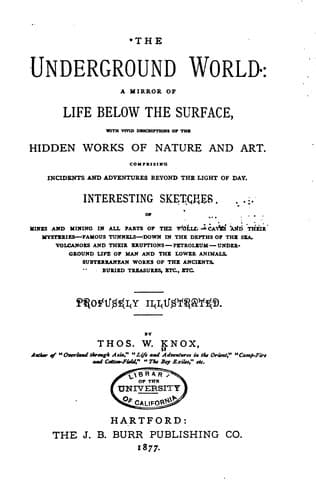
The Underground World: A mirror of life below the surfaceKnox, Thomas Wallace
History
The Underground World: A mirror of life below the surface
Knox, Thomas Wallace
Caves; Mines and mineral resources; Social history -- 19th century; Tunnels
HOW DIAMONDS ARE OBTAINED.—THE COUNTRIES THAT PRODUCE THEM.—MODES
OF SEEKING THEM IN BRAZIL.—CURIOUS PRECAUTIONS AGAINST THEFT.—HOW
A SLAVE IN BORNEO ROBBED HIS EMPLOYER.—FAMOUS DIAMONDS AND THEIR
HISTORY.—THE REGENT, THE ORLOFF, AND THE KOHINOOR.—FIDELITY OF
A SERVANT.—THE STAR OF THE SOUTH.—A SHARP TRICK OF AN AMATEUR
GAMBLER.
The hardest known mineral in the world, and at the same time the most
valuable, is the diamond. It cannot be cut or scratched by any other
substance. In cutting the diamond, another diamond, or the dust of
one, must be used. The process of polishing these stones by rubbing
two of them together was probably known in Asia a great many years
ago; but it was not introduced into Europe until the middle of the
fifteenth century. The diamond-cutters of Asia preserved the secret
of their work very carefully long after these valuable stones were
brought to Europe. About the middle of the fifteenth century, Louis
Berquen, of Bruges, accidentally discovered that by rubbing two
diamonds together, their surfaces might be cut. The powder obtained in
this way is used for polishing the stone.
The diamond must first be dug from the earth, and if we only knew
where to find them we could doubtless discover richer gems than any
of those now known. The earth which contains the diamond is worked
in the same way as the auriferous gravels, both having been produced
by the same causes. Gold occurs in the beds or streams, by the
disintegration of the rocks, in which it was originally contained,
and their gradual wearing and washing away. Diamonds were originally
contained in the rocks in the same way that gold was held there, and
the process of disintegration has been pretty much the same. Many
of the places where gold is found contained diamonds; and in some
localities in California the sands are now being reworked to obtain
any small particles of gold that may have been left, and also to
obtain diamonds. The original gold-seeker looked only for the yellow
metal. The gold-seeker of to-day searches not only for gold, but for
hard pebbles, which may prove rough diamonds.
[Sidenote: WHERE DIAMONDS ARE FOUND.]
Public-domain text, read in full here on John Shaqi.
Reviews
Reviews
No reviews yet
Be the first to share your thoughts on this work.
Elsewhere in the archive
Join the Discussion
Join the discussion
Sign in to leave a comment or review.
Sign InorCreate an account