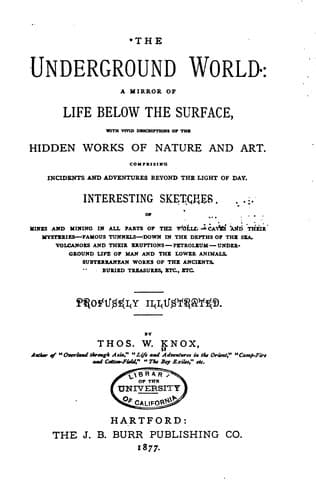
The Underground World: A mirror of life below the surfaceKnox, Thomas Wallace
History
The Underground World: A mirror of life below the surface
Knox, Thomas Wallace
Caves; Mines and mineral resources; Social history -- 19th century; Tunnels
He had prepared himself for the work with the assistance of a surgeon,
who shared with him the proceeds of the enterprise. The surgeon placed
a ball, somewhat larger than a pea, in the fleshy part of the man’s
thigh; kept down the irritation as much as possible, and allowed the
flesh to grow over the wound, or nearly so. The ball was then taken
out, leaving a comfortable cavity a quarter of an inch below the skin.
A small opening was made, and the skin at the opening was allowed to
grow around a steel rod about half as large as the diameter of the
cavity. In this way a very fine receptacle was formed for the deposit
of the diamond.
It took some time to get it up, but when finished it was entirely
satisfactory, and the man was sure of having his pocket always
about him. When he found a diamond that could be crowded into this
cavity, he would manage to stow it away; and then, at the earliest
opportunity, he repaired to the office of the surgeon, where the
diamond was removed with the aid of a pair of forceps. They did not
strike for the largest diamonds, and were doubtless more successful in
this mode of working than if they had planned their enterprise on a
grander scale.
It is a general principle in chemistry, that when the component parts
of an article are well known, a counterfeit can be produced, provided
the component parts are attainable. But it is not so with the diamond.
For hundreds of years chemists have labored to produce this stone.
They know perfectly well of what it is composed, but they cannot
repeat it. The diamond is nothing more than pure crystallized carbon,
and placed under a great heat it boils and disappears. It is not acted
upon by acids or alkalies, and when kept in the open air, it may be
heated to a high degree without damage. Exposed to the intense heat
produced by a Bunsen burner, it is converted into coke; and if it is
heated in the open air, it boils at the temperature of melting silver,
and disappears in the form of carbonic acid gas. If the sun’s rays are
converged to a focus by means of a lens, and directed upon a diamond
under a bell-glass filled with oxygen gas, the diamond will burn; and
when it is consumed, carbonic acid will be found beneath the glass.
Thus the most precious substance in the known world can be made to
disappear.
[Sidenote: HOW TO KNOW THE VALUE OF DIAMONDS.]
Public-domain text, read in full here on John Shaqi.
Reviews
Reviews
No reviews yet
Be the first to share your thoughts on this work.
Elsewhere in the archive
Join the Discussion
Join the discussion
Sign in to leave a comment or review.
Sign InorCreate an account