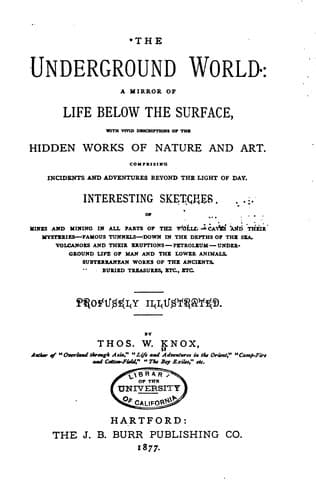
The Underground World: A mirror of life below the surfaceKnox, Thomas Wallace
History
The Underground World: A mirror of life below the surface
Knox, Thomas Wallace
Caves; Mines and mineral resources; Social history -- 19th century; Tunnels
The diamond is sold by its weight, estimated in carats,—a carat being
equal to three and one fourth grains Troy, and subdivided into half,
quarter, eighth, and so on. It is difficult to say what a rough
diamond is worth, since a great many reasons may occur to cause its
fluctuation in value. The ordinary estimate for a cut diamond is sixty
dollars a carat, that is to say, when the stone weighs a single carat.
The price of the diamond exceeding a carat is not in proportion to
its weight, but by the square of the weight, that is to say, to the
weight multiplied by itself. Thus, if a diamond weighing one carat is
worth sixty dollars, one which weighs two carats is worth 2 × 2, and
then multiplied by sixty, or two hundred and forty dollars. A stone of
three carats is worth 3 × 3, multiplied by sixty, or five hundred and
forty dollars. The value, therefore, of a polished diamond is found by
multiplying the square of the weight by the price of a stone of one
carat. This is the rule generally given for the pricing of diamonds;
but the value of each stone varies more or less according to its
character, so that one stone weighing fifteen carats might be worth
three or four thousand dollars more than another stone of the same
weight. The best rule, probably, for obtaining the price of diamonds,
is to ask a man who has them for sale. Diamonds are sold very much
like any other commodity, that is, for the highest price the purchaser
is willing to pay.
Diamonds, especially those of a large size, require, it is needless to
say, great care in keeping, to save them from being stolen. The crown
jewels of England are kept in the Tower of London in an iron cage
surrounded with glass. Some of them are of great antiquity. The crown
jewels include not only diamonds, but some valuable rubies, sapphires,
emeralds, and pearls. The crown contains a heart-shaped ruby, which is
said to have been given to Edward the Black Prince by Don Pedro, King
of Castile, after the battle of Najera, A. D. 1367.
[Sidenote: FAMOUS STONES.]
It was afterwards worn in the helmet of Henry V., at the battle of
Agincourt, in the year 1415.
The crown jewels of France disappeared in 1792, during the troubles of
the first republic, though they were kept under seal, and in the royal
treasury. Some of them were afterwards found buried in an obscure
place, which was named in an anonymous letter sent to the prime
minister. The famous Regent diamond was in this casket.
Public-domain text, read in full here on John Shaqi.
Reviews
Reviews
No reviews yet
Be the first to share your thoughts on this work.
Elsewhere in the archive
Join the Discussion
Join the discussion
Sign in to leave a comment or review.
Sign InorCreate an account