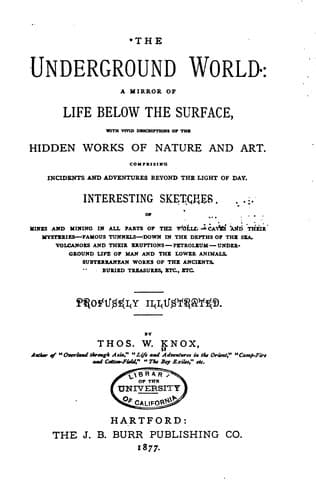
The Underground World: A mirror of life below the surfaceKnox, Thomas Wallace
History
The Underground World: A mirror of life below the surface
Knox, Thomas Wallace
Caves; Mines and mineral resources; Social history -- 19th century; Tunnels
At a given signal, we began our journey into the East River, and
descended until we reached what our conductor termed the “lock.” Here
we changed our stands again, and entered the lock by crawling through
an opening at the bottom of the elevator sufficiently large for a man
of ordinary size to pass easily. This lock is an oblong iron box,
or boiler, of just sufficient size to allow half a dozen persons to
stand erect. It is eight feet long, and six feet in diameter. At the
bottom of the lock there is an iron door or opening, similar to that
through which we entered, which gives admission to the interior of the
caisson. These iron doors are fitted with rubber, so as to make them
perfectly air-tight.
When we had all entered, the door was closed upon us. We looked at
each other, wondering what would be done next, and we soon found out.
Our conductor, previous to starting the lock, gave us what he termed
a few useful hints, so that we might be able to make the trip as
agreeable as possible under all the circumstances.
“Now, gentlemen,” said he, “in descending, you will find a
disagreeable sensation, particularly about your ears. You will
find great ease by closing the nostrils every few seconds,—as the
pressure of the air will act upon the tympanum of the ear,—and also by
inflating your cheeks to their full extent.”
These instructions were given that we might cause an artificial
pressure upon the inside of the ear, and thus prevent its rupture.
Our conductor then proceeded to turn a cock, to admit the air forced
from above. In a moment it rushed in with a tremendous force, making
a noise similar to that of a locomotive blowing off steam. The
effect of this was anything but pleasant. A sudden deafness seemed to
overtake us, as if a cannon had been fired under our noses; our voices
were also changed, and appeared cracked, and we almost wished our
curiosity had not led us so far.
[Sidenote: A HEAVY PRESSURE OF AIR.]
This feeling was caused by the air rushing too fast into the orifice
of the ear. There was just sufficient light inside the lock to discern
our faces, and that was all. It took five or six minutes to get the
necessary amount of pressure into the lock, and then the air was
turned off.
We seemed suddenly to lose our footing, and then to regain it; and no
sooner had we righted ourselves than we had another sudden shoot, and
this continued until we reached the bottom. The actual descent was
made in about a minute and a half, or perhaps two minutes; but owing
to the pain we suffered, it appeared to be three times as long.
Public-domain text, read in full here on John Shaqi.
Reviews
Reviews
No reviews yet
Be the first to share your thoughts on this work.
Elsewhere in the archive
Join the Discussion
Join the discussion
Sign in to leave a comment or review.
Sign InorCreate an account