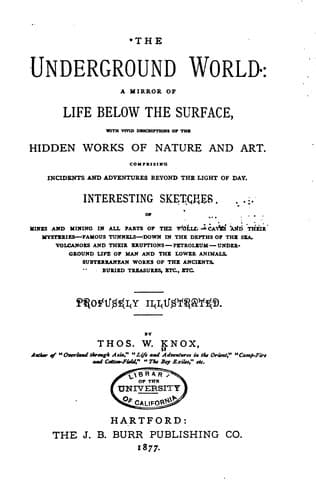
The Underground World: A mirror of life below the surfaceKnox, Thomas Wallace
History
The Underground World: A mirror of life below the surface
Knox, Thomas Wallace
Caves; Mines and mineral resources; Social history -- 19th century; Tunnels
The sensation we experienced was certainly very disagreeable and
painful, and for a pleasure trip I certainly would not recommend
any one to undertake the journey. Should a lady go down, however
strong-minded she might be, I would not answer for the consequences.
One of the party was so much affected by the pressure of the air that
our conductor had to turn off the cock frequently. The stranger’s ears
pained him greatly, and blood began to spurt from them.
Having reached the bottom of the caisson, where the workmen were
digging out the earth and blasting rock, we were detained in the lock
some minutes, to allow the admission of air of the same density as
that below. This being done, I descended a short iron ladder leading
into the bottom of the caisson, and speedily found myself standing on
the bed of the river, seventy-eight feet below water-mark.
There were several men working in their shirt sleeves, with big drops
of perspiration rolling off their cheeks. The subterranean vault was
very well lighted with gas forced down the pipes in the same manner as
the air; and it is a curious fact, that in the compressed air a foot
burner gives as much light as a four foot one would in the ordinary
atmosphere. The caisson seemed to be full of steam, as if a hundred
washerwomen were plying their avocation at the tub. The bottom of the
caisson is divided into several chambers by means of iron and wood
partitions, with entrances leading into each other. The air does not
seem impure nor unpleasant. According to an examination made a few
days before my visit, it was then found to contain a small percentage
of carbonic acid, but not enough to do any harm.
[Sidenote: OPERATIONS BELOW.]
As soon as the sand is dug, it is sent up various pipes, four inches
in diameter, which operate in the same way as siphons. It is odd to
notice with what force the sand ascends to the top of the caisson, and
it is all that six men can do to shovel it in fast enough. Boulders of
trap rock were found embedded in the quicksand. These were broken up
and hoisted out by an apparatus similar to a dredging machine, working
in an immense shaft filled with water.
The shape of the interior of the caisson resembles very much the
lips of an enormous bell, and in reality it is worked upon the same
principle as an ordinary diving-bell, the water being kept out by the
great pressure of air. As soon as the caisson is perfectly settled,
and all the sand and debris down to the bed rock is removed, the
interior is filled with concrete and masonry, and thus the pier
obtains a foundation perfectly solid.
Public-domain text, read in full here on John Shaqi.
Reviews
Reviews
No reviews yet
Be the first to share your thoughts on this work.
Elsewhere in the archive
Join the Discussion
Join the discussion
Sign in to leave a comment or review.
Sign InorCreate an account