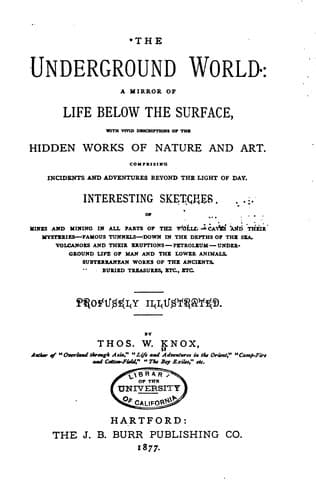
The Underground World: A mirror of life below the surfaceKnox, Thomas Wallace
History
The Underground World: A mirror of life below the surface
Knox, Thomas Wallace
Caves; Mines and mineral resources; Social history -- 19th century; Tunnels
At the end of a week, Giraud’s companion died of exhaustion and
starvation. Giraud was a man of great strength, both of mind and body,
and bore up as well as he could under his suffering. The dead body of
his companion, which lay near him, poisoned the little air he had to
breathe; but somehow he lived day after day for a whole month. Every
moment his rescuers expected to reach him, when some fresh accident
occurred, and much of the work had to be done over again. On the
thirtieth day they reached the prison, and Giraud was saved.
He was wasted to a skeleton, and unable to stand. His body was a mass
of sores; gangrene had attacked all his limbs, caused by the corpse
which had been rotting at his side for three weeks. He was carried to
the hospital, and every attention was given him; but he had suffered
too much, and died within a month of the day of his rescue.
Occasionally masses of rock drop from the roof without the least
warning, and fall upon the heads of the miners. Sometimes a man may
escape with the loss of a limb, or he may be killed outright. In other
cases, the walls and timbers give way, and men are crushed beneath
their weight.
A story is told of a miner who was caught by the fall of some coal
which nearly crushed him, but he had sufficient strength remaining
to call for help. A comrade heard him, and gave the alarm. All the
men who could work in the small space were immediately gathered; and
a part of the coal having been removed from around the sufferer his
head and one of his hands became visible. He was lying on his right
side upon the floor of the gallery, with his legs doubled beneath him.
There was a mass of broken timber above him, so that he could not
move, but fortunately his chest was not compressed. Air was supplied
him by means of a ventilator and a tube. The rails and some of the
other timbers by which he was enclosed were cut through, and a space
was opened in such a way as to reach him from below. He did not lose
courage a moment; he remained perfectly cool, and gave his preservers
several useful suggestions. Finally, after six hours of suffering, he
was removed.
In several instances miners have been enclosed in such a way that
escape was impossible. All efforts to relieve them were unavailing,
and those who remained uninjured from the fall of the rock died of
suffocation or starvation.
[Sidenote: AN IRISHMAN’S JOKE.]
Public-domain text, read in full here on John Shaqi.
Reviews
Reviews
No reviews yet
Be the first to share your thoughts on this work.
Elsewhere in the archive
Join the Discussion
Join the discussion
Sign in to leave a comment or review.
Sign InorCreate an account