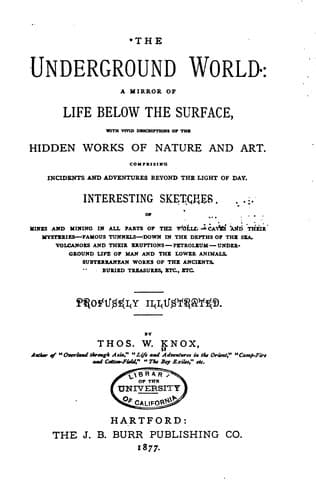
The Underground World: A mirror of life below the surfaceKnox, Thomas Wallace
History
The Underground World: A mirror of life below the surface
Knox, Thomas Wallace
Caves; Mines and mineral resources; Social history -- 19th century; Tunnels
Let us change a moment from the horrible to the ludicrous. A few
months ago, an Irishman, who was digging a well in Illinois, left his
work, and went to breakfast. When he returned, he found that the earth
had caved in. There was a clump of trees a few yards away, and after
looking around to ascertain if any one was in sight, and knowing that
some friend would be there shortly, he took off his coat, hung it upon
a post, and then, taking his shovel and pick, retired to the shelter
of the trees. He had just concealed himself, when his friends made
their appearance. They saw the coat hanging upon the post, and they
saw that the earth had caved in. Immediately concluding that their
friend was buried below, they set at work to rescue him.
They worked with the greatest energy for two or three hours, and at
the end of that time had removed all the fallen earth. But no Pat
was there. Just as they were wondering what had become of him, he
walked leisurely from his place of concealment, and thanked them for
what they had done. At first they were inclined to be indignant, but
finally concluded that it was a good joke, and a few drams of bad
whiskey removed all differences.
The danger of underground inundations is as great as that of falls of
earth. Water is constantly accumulating in a mine, and sometimes in
such quantities as to defy all attempts to keep it under control.
Miners have curious theories about streams of water which enter the
mines. Some of the English miners believe the earth is alive, and they
compare the veins of water in the earth to the veins and arteries of
the human body. Sometimes they say, “When the water breaks into our
working-places, it is the Earth which revenges itself upon us for
having cut one of his veins.” The Belgian miners have the same belief,
and they call the water which flows out of the coals, ‘_le sang de la
veine_,’ that is, ‘the blood of the vein.’
[Sidenote: FLOODING A MINE.]
Inundations of mines are frequently fatal. Sometimes the water enters
with great force. One day, in an English coal mine, the water fairly
drove out the auger with which the workmen were boring a hole. It
came as if from the nozzle of a fire engine. The workmen made several
attempts to plug the hole, but could not, and were driven out. A few
hours later the mine was flooded. Pumping machinery was set up, but it
was not until the end of seven years that the water could be removed.
It was only then stopped by means of banking, that prevented its
further entrance.
In a mine near Newcastle, many years ago, there was an inundation
which enclosed ninety men in a place where it was impossible to
relieve them. Several persons, who were working close to the shaft
when the water entered, managed to escape, but they were very few
in number. The accident occurred in May, and it was not until the
following February that the bodies of the drowned men were recovered.
With one exception all were recognized.
Public-domain text, read in full here on John Shaqi.
Reviews
Reviews
No reviews yet
Be the first to share your thoughts on this work.
Elsewhere in the archive
Join the Discussion
Join the discussion
Sign in to leave a comment or review.
Sign InorCreate an account