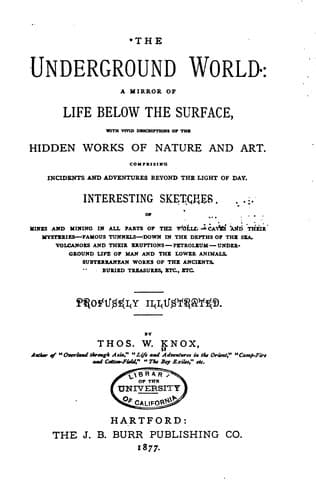
The Underground World: A mirror of life below the surfaceKnox, Thomas Wallace
History
The Underground World: A mirror of life below the surface
Knox, Thomas Wallace
Caves; Mines and mineral resources; Social history -- 19th century; Tunnels
At another coal mine, which was worked on the sea-shore, and extended
a distance of fifteen hundred yards under the Irish Sea, the manager,
in his anxiety to produce a large quantity of coal, recklessly cut
away some of the pillars which supported the roof. One day the whole
neighborhood was alarmed with the report that the mine had fallen in.
The commotion was so great that many persons on the shore observed the
whirl of the sea directly over the spot where the water entered. A few
of the laborers escaped, but thirty-six men and boys were drowned. The
accident happened more than thirty years ago. The coal mine is now,
and always must remain, under water, and the bodies have never been
recovered.
[Sidenote: DEATH BY SUFFOCATION.]
Some of the most terrible mining accidents are those which occur in
consequence of the closing of the shafts. Where a mine has two shafts
there is little liability of such accidents; but where there is only
a single shaft the danger is constantly threatening. The terrible
calamity at Avondale, which is fresh in the minds of many readers,
will be described elsewhere.
A similar accident at an English coal mine, a few years ago, was even
more terrible in its results than the calamity at Avondale.
The beam of the pumping engine gave way, and killed five men who were
at that moment coming up in the cage. One hundred and ninety-nine men
and boys were then working under ground. The enormous beam of the
engine weighed more than forty tons. In its fall it carried down all
the timbers of the shaft, damaging the walls in several places. The
rubbish and broken timbers accumulated in the shaft, and closed the
only mode of egress for the miners. The beam and timberings cut off
all connection between the interior of the mine and the outside world.
The mine was furnished with ventilating furnaces, in which a large
quantity of fuel was burning, and it was supposed that the imprisoned
miners died of suffocation within twenty-four hours. Some of the men
who were imprisoned tried to force an outlet, but they were unable to
do so, and died in the effort.
Many accidents of this kind might be described. In the various
coal-mining countries of the globe, they may be said, in the
aggregate, to be of almost weekly occurrence. Where the owners of
mines neglect or decline to provide their works with two entrances, it
is imperatively necessary, for the protection of life, that the law
should interfere, and compel them to do so.
[Sidenote: ACCIDENT AT A FRENCH MINE.]
A few years ago, at a mine in France, the engineer one day observed
that the cages did not work properly in the guides. Fifty-six yards
below the surface he discovered that the lining of the shaft deviated
from the perpendicular. The joints and displacements were visible at
several points. All the men, three hundred in number, were ordered to
leave the mine.
Public-domain text, read in full here on John Shaqi.
Reviews
Reviews
No reviews yet
Be the first to share your thoughts on this work.
Elsewhere in the archive
Join the Discussion
Join the discussion
Sign in to leave a comment or review.
Sign InorCreate an account