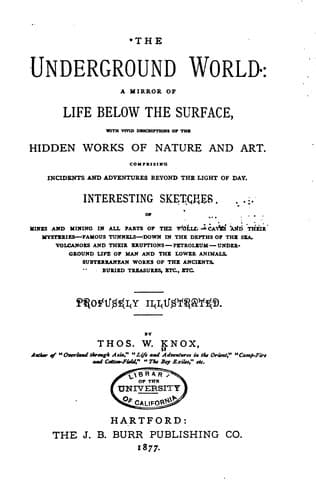
The Underground World: A mirror of life below the surfaceKnox, Thomas Wallace
History
The Underground World: A mirror of life below the surface
Knox, Thomas Wallace
Caves; Mines and mineral resources; Social history -- 19th century; Tunnels
According to an English report, there was one death for every two
hundred and sixteen persons employed in the mines. It was estimated
that one life was lost for every sixty-eight thousand tons of coal
obtained. In some districts of England the proportion was one life
lost for every twenty-two thousand tons. In the year 1866, six hundred
and fifty-one lives were lost from explosions of fire-damp. In the
previous year there were only one hundred and sixty-eight deaths from
the same cause. Altogether, in the year 1866, there were fourteen
hundred and eighty-four deaths from mining accidents in Great Britain
alone. The total number of deaths from all violent causes in the mines
of Great Britain, in ten years, was nine thousand nine hundred and
sixteen. Twenty per cent. of these were caused by fire-damp explosions.
The greatest number of lives lost at any one time through mining
accidents was at the Oaks Colliery, in 1866, when three hundred and
sixty-one miners lost their lives.
[Sidenote: GREAT LOSS OF LIFE.]
At the Hartley, Wigan, and Bury Collieries, many fearful accidents
have taken place within the past few years, whereby many lives were
lost. These accidents, in justice to the owners, or superintendents,
let it be said, are not always due to the want of precaution on
the part of the managers, but from gross neglect, or through
non-observance of the rules under which the mine is worked. For
example, the men were very careless in the use of the safety-lamps.
Every lamp is locked before it is given out, and every care is
taken to prevent its being opened. The men will occasionally amuse
themselves by trying to pick the locks, and that, too, in places where
the air is full of explosive gas. So accustomed are they to danger,
that they hold it in great contempt; and the result is, that fatal
accidents were much more common than if men were cautious and obedient.
At the time of the Oaks Colliery explosion, great sympathy was
manifested throughout England, just as was subsequently seen in the
Avondale disaster in America. For days after the occurrence, the daily
papers were filled with long details of the horror, the recovery of
the bodies of the victims, the distressing scenes at the mouth of the
mine, and at the graveyard, and the brave deeds of the men who were
fortunately absent from the mine at the time of the explosion.
Subscriptions were opened in nearly every church for the benefit of
the survivors, and at the suggestion of Queen Victoria, the then Lord
Mayor of London and Common Council held a public meeting to raise
money for the families of the victims. The appeals were liberally
responded to through the whole country. Many of the wives of the dead
miners received life pensions, and all the bereaved families were
placed above immediate want.
XXXI.
THE MAMMOTH CAVE.
Public-domain text, read in full here on John Shaqi.
Reviews
Reviews
No reviews yet
Be the first to share your thoughts on this work.
Elsewhere in the archive
Join the Discussion
Join the discussion
Sign in to leave a comment or review.
Sign InorCreate an account