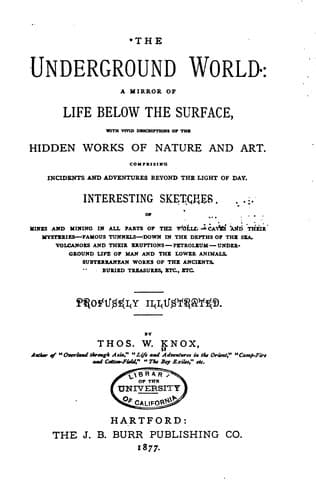
The Underground World: A mirror of life below the surfaceKnox, Thomas Wallace
History
The Underground World: A mirror of life below the surface
Knox, Thomas Wallace
Caves; Mines and mineral resources; Social history -- 19th century; Tunnels
ROMANCE AND MYSTERY OF CAVES.—THE FAMOUS CAVES OF THE WORLD.—THE
GREATEST CAVERN ON THE GLOBE.—ITS IMMENSE FAME.—AMERICANS’ NEGLECT
OF IT.—CAUSE OF THEIR INDIFFERENCE.—SITUATION OF THE MAMMOTH
CAVE.—ITS MISERABLE MANAGEMENT.—ANNOYANCES AND IMPOSITIONS
PRACTISED UPON TOURISTS.—JOURNEY THROUGH THE VAST TUNNEL.—WHAT
ONE SEES, FEELS, AND DOES.—CONSUMPTIVE GHOSTS.—WONDERS OF THE
STAR-CHAMBER.—DESCENT INTO THE BOTTOMLESS PIT.—CROSSING THE STYX
AND THE LETHE.—MARVELLOUS ECHOES.—STARTLING ACCIDENTS.—WOMEN IN
AWKWARD SITUATIONS.
Caves in all ages have been associated, not only with mystery and
romance, but with sorcery and superstition of every conceivable kind.
Fable and tradition have converted them into the abodes of demons
and witches, and history shows that robbers and law-breakers have
always made them places of refuge and shelter. Every mountainous
or picturesque region I have visited has abounded in witches’
caves, robbers’ caves, murderers’ caves, and caves generally, in
which supernatural rites and horrid deeds are supposed to have been
celebrated or committed. The dark, dreary, and weird quality of many
caves, added to their unique and fantastic formation and uncertain
windings naturally awake a feeling of awe, and appeal strongly and
strangely to the imagination.
The ancient priests, in order to influence favorably the minds of the
ignorant, pretended that the divinities they claimed to interpret
had their residence in deep and dreary caverns, and that thence they
revealed their mighty purpose to their mortal agents. The oracles
of Delphos, which princes and sages were wont to consult, were
interpreted, as it was assumed, by a priestess sitting at the mouth of
a cave, and claiming to predict the future of nations, and tell the
destiny of kings. The old Norsemen performed their barbarous rites in
caverns; the Indian Brahmins devoted caverns to religious purposes,
and from natural openings in the rocks constructed gorgeous temples.
These subterranean chambers were doubtless the earliest abodes of men,
and even now, in certain uncivilized regions, they are so employed.
Petra—the Sela and Joktheel of the Bible—continues to be visited as
a curiosity, because its ruins plainly indicate that its inhabitants
dwelt in spaces hewn out of the solid stone. That caverns were used
for the dead as well as for the living is evinced by the Catacombs of
Thebes, Rome, Naples, and Malta.
[Sidenote: MYSTERIES OF CAVES.]
Public-domain text, read in full here on John Shaqi.
Reviews
Reviews
No reviews yet
Be the first to share your thoughts on this work.
Elsewhere in the archive
Join the Discussion
Join the discussion
Sign in to leave a comment or review.
Sign InorCreate an account