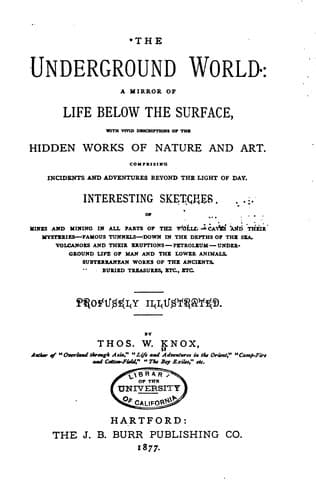
The Underground World: A mirror of life below the surfaceKnox, Thomas Wallace
History
The Underground World: A mirror of life below the surface
Knox, Thomas Wallace
Caves; Mines and mineral resources; Social history -- 19th century; Tunnels
The greatest caves known—new ones are constantly being discovered—are
of limestone, and of comparatively recent origin. Geology teaches that
the primary formations of caves are many, though small, being produced
by the action of water coursing through the strata, and that the
continuation of this process for ages creates the vast and beautiful
chambers, which all of us are so fond of exploring. Sweden and Norway
boast of granite vaults, especially Marienstadt, of extraordinary
dimensions, though some of them have been, as yet, but partially
penetrated. The vicinity of Quito contains caves of modern porphyry,
and the Isle of France caves of lava. Gurtshellir is a cavern of lava
in Iceland, forty feet high, fifty broad, and one mile long. The caves
of Agtelek in Hungary, and of Adelsberg in Carniola,—the latter noted
for its transparent white pillars and brilliant stalactites,—are among
the most remarkable in Europe.
Adelsberg has an unusual interest for naturalists, because a strange
reptile, called the proteus, half a lizard and half an eel, has its
habitat there. It has an extremely elastic constitution, and an
extraordinary adaptability, as may be inferred from the fact that
it subsists equally well on land or in water, imbedded in rock or
buried in mud, requiring neither air nor light, food nor drink, for
the sustainment of its existence. What an excellent _littérateur_ the
proteus would be as respects its limited necessities! If it happened
to be an unappreciated genius, like most literary men, it need not
feel any concern, for it could afford to wait until the world had
come round to it, and the age had grown worthy of its thought. Fame,
being a bubble, and therefore air, could not injure the nondescript
creature, nor could the throwing of mud, as is the custom of
journalists, mar it in the least. Much as it might be in (hot) water,
it would not be troubled, and as to detraction and misrepresentation,
its house would be (occasionally at least) built upon a rock, and
would therefore stand firm.
[Sidenote: THE CAVE OF GUACHARO.]
Public-domain text, read in full here on John Shaqi.
Reviews
Reviews
No reviews yet
Be the first to share your thoughts on this work.
Elsewhere in the archive
Join the Discussion
Join the discussion
Sign in to leave a comment or review.
Sign InorCreate an account