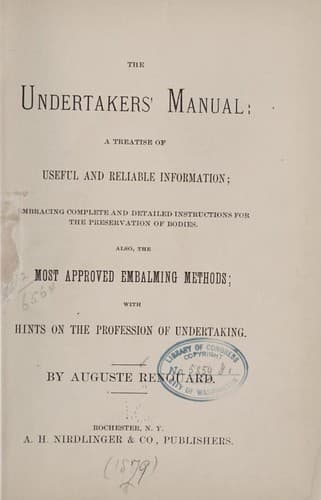
Under this heading, we will present to our readers an essay upon
the causes of the dissolution of the human body. The writer, Mr. W.
W. BALL, of Bangor, Michigan, who published the following in THE
CASKET of March, 1877, has kindly allowed us to republish it, for
the benefit of those who have not read it, and also as a proof that
the theories advanced in this volume cannot be refuted. We give the
article at length. The statements advanced in the essay, also the
course of treatment adopted in the preservation of bodies, will be
found to possess great similarity with the different methods herein
given.
BY W. W. BALL.
As soon as the vital action ceases, decomposition ensues in the
substances which were before the very elements of life, viz.:
blood, lymph, chyme, chyle and gastric juice, become active agents
in its destruction.
In the blood, the most important agent during life, as soon as
life ceases it becomes one of the first to produce that blackened,
putrid and sloughing condition we find shortly after death. The
blood being
left in every part of the body, it breaks up and forms new
compounds, of which only a general outline is attainable, for want
of definite chemical analysis or microscopical observation. The
fibrine and serum separate; the former, which contains most of the
red corpuscles, albumen, saline and fatty substances, glutinates or
coagulates on the sides of the vessels themselves, while the serum
permeates the surrounding tissues, uniting with oxygen carried off
from the pulmonary structure during life, and these, having an
affinity for the tissues, form those compounds termed sulphuretted
and carburetted hydrogen gases, giving rise to that effluvium which
characterize deceased bodies.
CONDITION OF THE BLOOD.
After death the blood is found in two forms. This is owing to certain
diseases and circumstances. The first is encountered when death
has ensued after a long stage of sickness. The vital fluids become
exhausted by disease, and the organs of circulation become too weak
to perform their office of circulating the fluid they contain; hence,
dissolution takes place in the blood from want of constant and rapid
action. Thus the fibrine becomes lodged and coagulated in the veins
and capillary system. The fibrine and serum separate, leaving the
fibrine coagulated or clotted, and the serum, a transparent, fatty or
oily liquid, permeates the tissues of the flesh. Usually the arteries
are found without any blood remaining in them. In instances of this
kind there will be no difficulty encountered from the corpse turning
black, as the gases cannot force the blood to the surface into the
capillary system, because the fibrine is lodged elsewhere, but the
flesh may turn brown or saffron color to some extent.
DIFFICULT CASES.
Public-domain text, read in full here on John Shaqi.
Reviews
Reviews
No reviews yet
Be the first to share your thoughts on this work.
Elsewhere in the archive
Join the Discussion
Join the discussion
Sign in to leave a comment or review.
Sign InorCreate an account