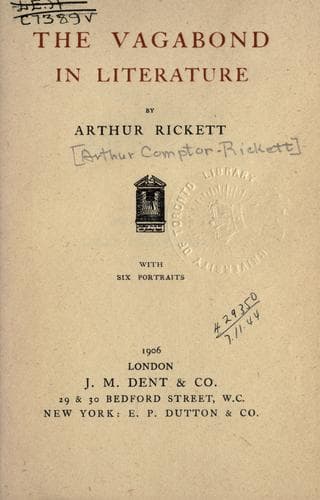
Bohemianism; English literature -- 19th century -- History and criticism
And so on, in a vein of courageous cheer, spoken with the big, obtrusive,
genial egotism that always meets us in Whitman’s writings. Whitman’s
egotism proves very exasperating to some readers, but I do not think it
should trouble us much. After all it is the egotism of a simple,
natural, sincere nature; there is no self-satisfied smirk about it, no
arrogance. He is conscious of his powers, and is quite frank in letting
you know this. Perhaps his boisterous delight in his own prowess may jar
occasionally on the nerves; but how much better than the affected
humility of some writers. And the more you study his writings the less
does this egotism affect even the susceptible. Your ears get attuned to
the pitch of the voice, you realize that the big drum is beaten with a
purpose. For it must be remembered that it is an egotism entirely
emptied of condescension. He is vain certainly, but mainly because he
glories in the common heritage, because he feels he is one of the common
people. He is proud assuredly, but it is pride that exults in traits
that he shares in common with the artist, the soldier, and the sailor.
He is no writer who plays down to the masses, who will prophesy fair
things—like the mere demagogue—in order to win their favour. And it is a
proof of his plain speaking, of his fearless candour, that for the most
part the very men for whom he wrote care little for him.
Conventionality rules every class in the community. Whitman’s gospel of
social equality is not altogether welcome to the average man. One
remembers Mr. Barrie’s pleasant satire of social distinction in _The
Admirable Crichton_, where the butler resents his radical master’s
suggestion that no real difference separates employer and employed. He
thinks it quite in keeping with the eternal fitness of things that his
master should assert the prerogative of “Upper Dog,” and points out how
that there are many social grades below stairs, and that an elaborate
hierarchy separates the butler at one end from the “odds and ends” at the
other.
In like manner the ordinary citizen resents Whitman’s genuine democratic
spirit, greatly preferring the sentimental Whiggism of Tennyson.
Whitman reminds us by his treatment of the vulgar, the ordinary, the
commonplace, that he signalizes a new departure in literature. Of poets
about the people there have been many, but he is the first genuine Poet
_of_ the People.
Art is in its essence aristocratic, it strives after selectness, eschews
the trivial and the trite. There is, therefore, in literature always a
tendency towards conservatism; the literary artist grows more and more
fastidious in his choice of words; the cheap and vulgar must be
rigorously excluded, and only those words carrying with them stately and
beautiful associations are to be countenanced. Thus Classicism in Art
constantly needs the freshening, broadening influence of Romanticism.
Public-domain text, read in full here on John Shaqi.
Reviews
Reviews
No reviews yet
Be the first to share your thoughts on this work.
Elsewhere in the archive
Join the Discussion
Join the discussion
Sign in to leave a comment or review.
Sign InorCreate an account