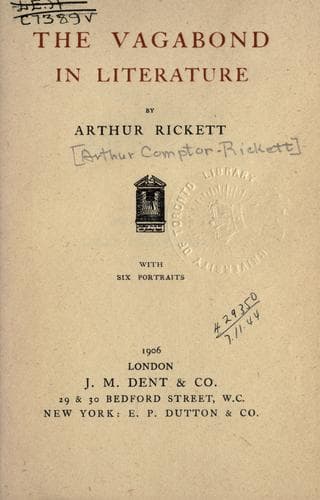
Bohemianism; English literature -- 19th century -- History and criticism
What Conservatism and Liberalism are to Politics Classicism and
Romanticism are to Art. Romantic revolutions have swept over literature
before the nineteenth century, and Shakespeare was the first of our great
Romantics. Then with the reaction Formalism and Conservatism crept in
again. But the Romantic Revival at the beginning of the nineteenth
century went much further than previous ones. Out of the throes of the
Industrial Revolution had been born a lusty, clamorous infant that
demanded recognition—the new Demos. And it claimed not only recognition
in politics, but recognition in literature. Wordsworth and Shelley
essayed to speak for it with varying success; but Wordsworth was too
exclusive, and Shelley—the most sympathetic of all our poets till the
coming of Browning—was too ethereal in his manner. Like his own skylark,
he sang to us poised midway between earth and heaven; a more emphatically
flesh and blood personage was wanted.
Here and there a writer of genuine democratic feeling, like Ebenezer
Elliott, voiced the aspirations of the people, but only on one side.
Thomas Hood and Mrs. Browning sounded a deeper note; but the huge,
clamorous populace needed a yet fuller note, a more penetrating insight,
a more forceful utterance. And in America, with its seething democracy—a
democracy more urgent, more insistent than our own—it found its
spokesman. That it did not recognize him, and is only just beginning to
do so, is not remarkable. It did not recognize him, for it had scarcely
recognized itself. Only dimly did it realize its wants and aspirations.
Whitman divined them; he is the Demos made articulate.
And not only did he sweep away the Conservative traditions and
conventions of literature, he endeavoured to overthrow the aristocratic
principle that underlies it. Selectness he would replace with
simplicity. No doubt he went too far. That is of small moment.
Exaggeration and over-emphasis have their place in the scheme of things.
A thunderstorm may be wanted to clear the air, and if it does
incidentally some slight damage to crops and trees it is of no use
grumbling.
But in the main Whitman’s theory of Art was very true and finely
suggestive, and is certainly not the view of a man who cares for nothing
but the wild and barbaric.
“The art of Art, the glory of expression, and the sunshine of the
light of letters is simplicity. Nothing is better than simplicity,
nothing can make up for excess or for the lack of definiteness. To
carry on the heave of impulse, and pierce intellectual depths, and
give all subjects their articulations, are powers neither common nor
very uncommon. But to speak in literature with the perfect rectitude
and insouciance of the movements of animals and the unimpeachableness
of the sentiment of trees in the woods, and grass by the woodside, is
the flawless triumph of Art.”
Public-domain text, read in full here on John Shaqi.
Reviews
Reviews
No reviews yet
Be the first to share your thoughts on this work.
Elsewhere in the archive
Join the Discussion
Join the discussion
Sign in to leave a comment or review.
Sign InorCreate an account