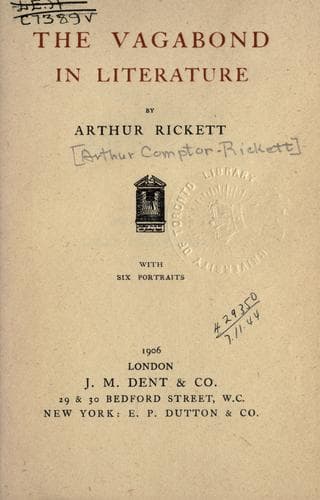
Bohemianism; English literature -- 19th century -- History and criticism
Whitman is no moralist, and has no formal philosophy to offer. But the
modern spirit which always seeks after some “criticism of life” does not
forsake even the Vagabond. He is certainly the only Vagabond, with the
exception of Thoreau, who has felt himself charged with a message for his
fellows. The popular tendency is to look for a “message” in all literary
artists, and the result is that the art in question is knocked sometimes
out of all shape in order to wrest from it some creed or ethical
teaching. And as the particular message usually happens to be something
that especially appeals to the seeker, the number of conflicting messages
wrung from the unfortunate literary artist are somewhat disconcerting.
But in Whitman’s case the task of the message hunter is quite simple.
Whitman never leaves us in doubt what he believes in, and what ideas he
wishes to propagate. It is of course easy—perhaps inevitable—that with a
writer whose method it is to hint, suggest, indicate, rather than
formulate, elaborate, codify, the student should read in more than was
intended. And, after all, as George Eliot said, “The words of Genius
bear a wider meaning than the thought which prompted them.” But at any
rate there is no mistaking the general outline of his thought, for his
outlook upon life is as distinctive as Browning’s, and indeed possesses
many points of similarity. But in speaking of Whitman’s message one
thing must be borne in mind. Whitman’s work must not be adjudged merely
as a special blend of Altruism and Individualism. No man ever works, it
has been well said {199}—not even if philanthropy be his trade—from the
primary impulse to help or console other people, any more than his body
performs its functions for the sake of other people. And what Professor
Nettleship says of Browning might be applied with equal truth to Whitman.
His work consists “not in his being a teacher, or even wanting to be one,
but in his doing exactly the work he liked best and could not help
doing.” And Whitman’s stimulating thought is not the less true for that,
for it is the spontaneous expression of his personality, just as fully as
a melody or picture is an expression of an artist’s personality. He
could no more help being a teacher than he could help breathing. And his
teaching must be valued not in accordance with the philosophy of the
schools, not by comparison with the ethics of the professional moralist,
but as the natural and inevitable outcome of his personality and
temperament.
As a panacea for social evils Whitman believes in the remedial power of
comradeship in a large-hearted charity.
“You felons on trial in courts,
You convicts in prison cells, you sentenced assassins chained and
handcuffed with iron,
Who am I, too, that I am not on trial or in prison?
Me ruthless and devilish as any, that my wrists are not chained
With iron, or my ankles with iron?”
Public-domain text, read in full here on John Shaqi.
Reviews
Reviews
No reviews yet
Be the first to share your thoughts on this work.
Elsewhere in the archive
Join the Discussion
Join the discussion
Sign in to leave a comment or review.
Sign InorCreate an account