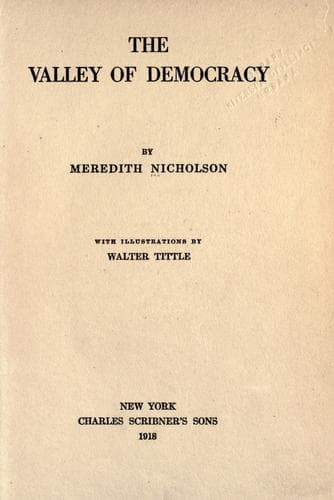
Mississippi River Valley -- Social life and customs
There is hardly another American State in which the social organization
may be observed as readily as in Kansas. For the reason that its
history and the later “social scene” constitute so compact a picture
I find myself returning to it frequently for illustrations and
comparisons. Born amid tribulation, having indeed been subjected to the
ordeal of fire, Kansas marks Puritanism’s farthest west; her people
are still proud to call their State “The Child of Plymouth Rock.” The
New Englanders who settled the northeastern part of the Territory were
augmented after the Civil War by men of New England stock who had
established themselves in Ohio, Illinois, and Iowa when the war began,
and having acquired soldiers’ homestead rights made use of them to
pre-empt land in the younger commonwealth. The influx of veterans after
Appomattox sealed the right of Kansas to be called a typical American
State. “Kansas sent practically every able-bodied man of military age
to the Civil War,” says Mr. William Allen White, “and when they came
back literally hundreds of thousands of other soldiers came with them
and took homesteads.” For thirty years after Kansas attained Statehood
her New Englanders were a dominating factor in her development,
and their influence is still clearly perceptible. The State may be
considered almost as one vast plantation, peopled by industrious,
aspiring men and women. Class distinctions are little known; snobbery,
where it exists, hides itself to avoid ridicule; the State abounds in
the “comfortably well off” and the “well-to-do”; millionaires are few
and well tamed; every other family boasts an automobile.
While the political and economic results of the Civil War have been
much written of, its influence upon the common relationships of life
in the border States that it so profoundly affected are hardly less
interesting. The pioneer period was becoming a memory, the conditions
of life had grown comfortable, and there was ease in Zion when the
young generation met a new demand upon their courage. Many were
permanently lifted out of the sphere to which they were born and
thrust forth into new avenues of opportunity. This was not of course
peculiar to the West, though in the Mississippi valley the effects
were so closely intermixed with those of the strenuous post-bellum
political history that they are indelibly written into the record.
Local hostilities aroused by the conflict were of long duration; the
copperhead was never forgiven for his disloyalty; it is remembered to
this day against his descendants. Men who, in all likelihood, would
have died in obscurity but for the changes and chances of war rose to
high position. The most conspicuous of such instances is afforded by
Grant, whose circumstances and prospects were the poorest when Fame
flung open her doors to him.
Public-domain text, read in full here on John Shaqi.
Reviews
Reviews
No reviews yet
Be the first to share your thoughts on this work.
Join the Discussion
Join the discussion
Sign in to leave a comment or review.
Sign InorCreate an account