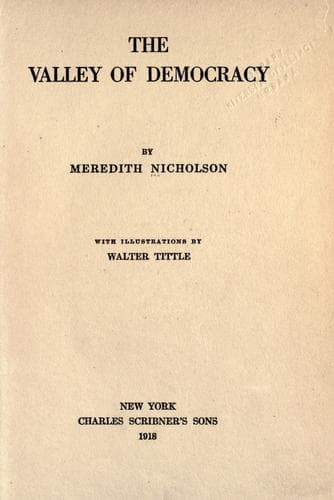
Mississippi River Valley -- Social life and customs
In the early eighties one might stand by the lakeside and be very
conscious of a West beyond that was still in a pioneer stage. At the
department headquarters of the army might be met hardy campaigners
against the Indians of mountain and plain who were still a little
apprehensive that the telegraph might demand orders for the movement
of troops against hostile red men along the vanishing frontiers.
The battle of Wounded Knee, in which 100 warriors and 120 women and
children were found dead on the field (December 29, 1890), might almost
have been observed from a parlor-car window. It may have been that on
my visits I chanced to touch circles dominated by Civil War veterans,
but great numbers of these diverted their energies to peaceful channels
in Chicago at the end of the rebellion, and they gave color to the
city life. It was a part of the upbringing of a mid-Western boy of my
generation to reverence the heroes of the sixties, and it was fitting
that in the land of Lincoln and in a State that gave Grant a regiment
and started him toward immortality there should be frequent reunions
of veterans, and political assemblages and agitations in which they
figured, to encourage hero-worship in the young. Unforgettable among
the more distinguished of these Civil War veterans was General John
A. Logan, sometime senator in Congress and Blaine’s running mate in
1884. In life he was a gallant and winning figure, and Saint Gaudens’s
equestrian statue in Grant Park preserves his memory in a city that
delighted to honor him.
Chicago’s attractions in those days included summer engagements of
Theodore Thomas’s orchestra, preceding Mr. Thomas’s removal to the city
and the founding of the orchestra that became his memorial. Concerts
were given in an exposition hall on the site now occupied by the Art
Institute, with railway-trains gayly disporting on the lake side of the
building. So persistent is the association of ideas, that to this day
I never hear the Fifth Symphony or the Tannhäuser Overture free of the
rumble and jar and screech of traffic. It was in keeping with Chicago’s
good-humored tolerance of the incongruous and discordant in those
years that the scores of Beethoven and Wagner should be punctuated by
locomotive whistles, and that _pianissimo_ passages should be drowned
in the grinding of brakes.
Public-domain text, read in full here on John Shaqi.
Reviews
Reviews
No reviews yet
Be the first to share your thoughts on this work.
Elsewhere in the archive
Join the Discussion
Join the discussion
Sign in to leave a comment or review.
Sign InorCreate an account