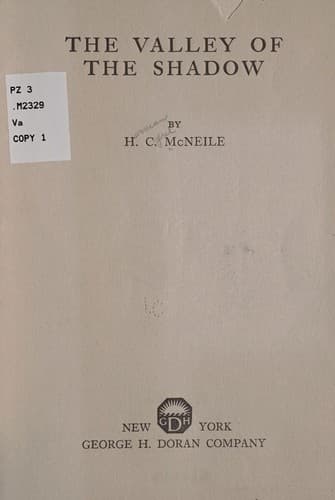
The Valley of the ShadowMcNeile, H. C. (Herman Cyril)
General
The Valley of the Shadow
McNeile, H. C. (Herman Cyril)
Attempted murder -- Fiction; Husband and wife -- Fiction; Short stories; Triangles (Interpersonal relations) -- Fiction
From that time on she had hardly ever slept a night away from the Pines.
For Hilda Garling had the instinct of playing the game very fully
developed. It was hypocrisy to pretend to herself that she loved him:
looking back on the five years of their married life she realized that
she never had loved him. Like so many girls fresh from the schoolroom,
she had been captivated by a brilliantly clever and handsome man some
fourteen years older than herself. She had thought herself in love with
him, and her parents, having inquired into Hubert Garling’s social and
financial status, and having found both—especially the latter—eminently
satisfactory, had put no obstacle in the way of what seemed to them a
very desirable match.
But even before the honeymoon was over disillusion had begun to set in.
That Hubert had a jealous nature she had found out while they were
engaged, and then she had been rather flattered by it. But until they
were married she never realized how fiendishly jealous he was. Once at
Nice, as they were on their way home, she had danced twice with a young
French officer, and the scene that night in their room had been
appalling. It had blown over, as such scenes do, but it had left an
indelible mark. It had frightened the girl—she was still only a child at
the time; but it had hastened her mental development far more than a
year of ordinary life. To her amazement she had found herself listening
to Hubert’s whispered apologies and love-makings with only half her
mind. The other half was disconcertingly cold and logical.
“This is insulting,” it said. “You may be his; in a way, since you’re
his wife, you are. But an outlook on life that forbids you to dance with
someone else, and gets furious if you do, is mediæval.”
As time went on it got no better. The slightest sign of interest in
another man was sufficient to precipitate either a furious scene or
sullenness, until Hilda for very peace’ sake confined her male
acquaintanceship to the old vicar of seventy-two and the doctor, who was
three years younger. And the absurd thing about it all was that there
had never been the tiniest particle of justification for her husband’s
attitude; never, that is, until—
Again she asked herself the question—Why had he asked Jack Denver to
stay? He was talking now to his guest in that charming, well-bred manner
of his that had captivated so many people—talking well and
interestingly, as a glance at Jack’s face revealed, though she hadn’t
heard a word that had been said for the last ten minutes. It was
incredible, impossible, that Hubert could know; after all, what was
there to know? Six months ago, on one of her rare visits to London, she
had stayed the night with an old school friend—Joan Prettyman. Mr.
Prettyman, Joan’s father, had tactfully gone up to Manchester on
business, and Joan had greeted her with a shout of joy.
Public-domain text, read in full here on John Shaqi.
Reviews
Reviews
No reviews yet
Be the first to share your thoughts on this work.
Join the Discussion
Join the discussion
Sign in to leave a comment or review.
Sign InorCreate an account