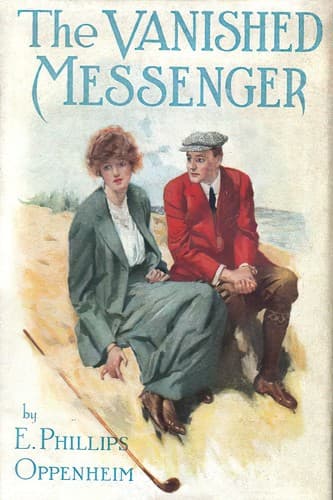
The Vanished MessengerOppenheim, E. Phillips (Edward Phillips)
General
The Vanished Messenger
Oppenheim, E. Phillips (Edward Phillips)
Detective and mystery stories; Fiction
“Why, because you are young and a girl,” he replied. “It’s natural to be
cheerful, isn’t it?”
“Is it?” she answered listlessly. “I cannot tell. I have not had much
experience.”
“How old are you?” he asked bluntly.
This time it certainly seemed as though her reply would contain some
rebuke for his curiosity. She glanced once more into his face, however,
and the instinctive desire to administer that well-deserved snub
passed away. He was so obviously interested, his question was asked
so naturally, that its spice of impertinence was as though it had not
existed.
“I am twenty-one,” she told him.
“And how long have you lived here?”
“Since I left boarding-school, four years ago.”
“Anywhere near where I am going to bury myself for a time, I wonder?” he
went on.
“That depends,” she replied. “Our only neighbours are the Lorneybrookes
of Market Burnham. Are you going there?”
He shook his head.
“I’ve got a little shanty of my own,” he explained, “quite close to St.
David’s Station. I’ve never even seen it yet.”
She vouchsafed some slight show of curiosity.
“Where is this shanty, as you call it?” she asked him.
“I really haven’t the faintest idea,” he replied. “I am looking for it
now. All I can tell you is that it stands just out of reach of the full
tides, on a piece of rock, dead on the beach and about a mile from the
station. It was built originally for a coastguard station and meant to
hold a lifeboat, but they found they could never launch the lifeboat
when they had it, so the man to whom all the foreshore and most of
the land around here belongs--a Mr. Fentolin, I believe--sold it to my
father. I expect the place has tumbled to pieces by this time, but I
thought I’d have a look at it.”
She was gazing at him steadfastly now, with parted lips.
“What is your name?” she demanded.
“Richard Hamel.”
“Hamel.”
She repeated it lingeringly. It seemed quite unfamiliar.
“Was your father a great friend of Mr. Fentolin’s, then?” she asked.
“I believe so, in a sort of way,” he answered. “My father was Hamel the
artist, you know. They made him an R.A. some time before he died. He
used to come out here and live in a tent. Then Mr. Fentolin let him use
this place and finally sold it to him. My father used often to speak to
me about it before he died.”
“Tell me,” she enquired, “I do not know much about these matters, but
have you any papers to prove that it was sold to your father and that
you have the right to occupy it now when you choose?”
He smiled.
“Of course I have,” he assured her. “As a matter of fact, as none of us
have been here for so long, I thought I’d better bring the title-deed,
or whatever they call it, along with me. It’s with the rest of my traps
at Norwich. Oh, the place belongs to me, right enough!” he went on,
smiling. “Don’t tell me that any one’s pulled it down, or that it’s
disappeared from the face of the earth?”
Public-domain text, read in full here on John Shaqi.
Reviews
Reviews
No reviews yet
Be the first to share your thoughts on this work.
Join the Discussion
Join the discussion
Sign in to leave a comment or review.
Sign InorCreate an account