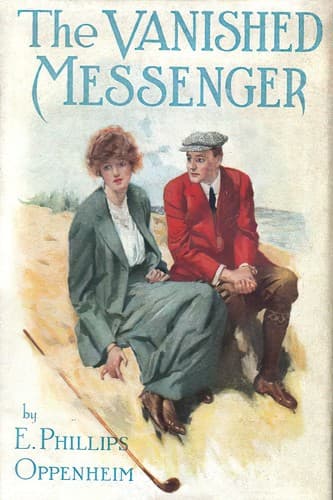
The Vanished MessengerOppenheim, E. Phillips (Edward Phillips)
General
The Vanished Messenger
Oppenheim, E. Phillips (Edward Phillips)
Detective and mystery stories; Fiction
“I cannot help it. I have told you what I think about Gerald and the
life he is compelled to live here. I don’t mind so much for myself, but
for him I think it is abominable.”
“The same as ever,” Mr. Fentolin sighed. “I fear that this little change
has done you no good, dear niece.”
“Change!” she echoed. “It was only a change of prisons.”
Mr. Fentolin shook his head slowly--a distressful gesture. Yet all the
time he had somehow the air of a man secretly gratified.
“You are beginning to depress me,” he announced. “I think that you can
go away. No, stop for just one moment. Stand there in the light. Dear
me, how unfortunate! Who would have thought that so beautiful a mother
could have so plain a daughter!”
She stood quite still before him, her hands crossed in front of her,
something of the look of the nun from whom the power of suffering has
gone in her still, cold face and steadfast eyes.
“Not a touch of colour,” he continued meditatively, “a figure straight
as my walking-stick. What a pity! And all the taste, nowadays, they tell
me, is in the other direction. The lank damsels have gone completely
out. We buried them with Oscar Wilde. Run along, my dear child. You do
not amuse me. You can take Gerald with you, if you will. I have nothing
to say to Gerald just now. He is in my good books. Is there anything
I can do for you, Gerald? Your allowance, for instance--a trifling
increase or an advance? I am in a generous humour.”
“Then grant me what I begged for the other day,” the boy answered
quickly. “Let me go to Sandhurst. I could enter my name next week for
the examinations, and I could pass to-morrow.”
Mr. Fentolin tapped the table thoughtfully with his forefinger.
“A little ungrateful, my dear boy,” he declared, “a little ungrateful
that, I think. Your confidence in yourself pleases me, though. You think
you could pass your examinations?”
“I did a set of papers last week,” the boy replied. “On the given
percentages I came out twelfth or better. Mr. Brown assured me that I
could go in for them at any moment. He promised to write you about it
before he left.”
Mr. Fentolin nodded gently.
“Now I come to think of it, I did have a letter from Mr. Brown,” he
remarked. “Rather an impertinence for a tutor, I thought it. He devoted
three pages towards impressing upon me the necessity of your adopting
some sort of a career.”
“He wrote because he thought it was his duty,” the boy said doggedly.
“So you want to be a soldier,” Mr. Fentolin continued musingly. “Well,
well, why not? Our picture galleries are full of them. There has been a
Fentolin in every great battle for the last five hundred years. Sailors,
too--plenty of them--and just a few diplomatists. Brave fellows! Not
one, I fancy,” he added, “like me--not one condemned to pass their days
in a perambulator. You are a fine fellow, Gerald--a regular Fentolin.
Getting on for six feet, aren’t you?”
“Six feet two, sir.”
Public-domain text, read in full here on John Shaqi.
Reviews
Reviews
No reviews yet
Be the first to share your thoughts on this work.
Join the Discussion
Join the discussion
Sign in to leave a comment or review.
Sign InorCreate an account