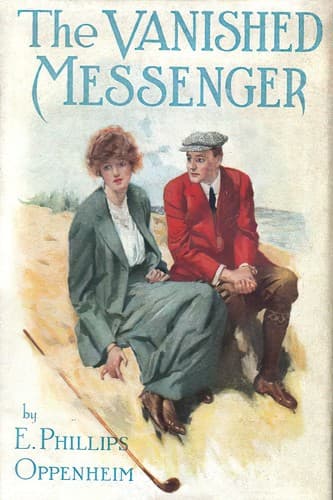
The Vanished MessengerOppenheim, E. Phillips (Edward Phillips)
General
The Vanished Messenger
Oppenheim, E. Phillips (Edward Phillips)
Detective and mystery stories; Fiction
Mr. Dunster frowned. For the first time he showed some signs of
uneasiness.
“Perhaps,” he muttered, half to himself, “a motor-car would have been
better.”
“Not on your life,” his young companion intervened. “All the roads to
the coast here cross no end of small bridges--much weaker affairs
than the railway bridges. I bet there are some of those down already.
Besides, you wouldn’t be able to see where you were going, on a night
like this.”
“There appears to be a chance,” Mr. Dunster remarked drily, “that you
will have to scratch for your competition to-morrow.”
“Also,” the young man observed, “that you will have taken this special
train for nothing. I can’t fancy the Harwich boat going out a night like
this.”
Mr. Dunster relapsed into stony but anxious silence. The train continued
its erratic progress, sometimes stopping altogether for a time, with
whistle blowing repeatedly; sometimes creeping along the metals as
though feeling its way to safety. At last, after a somewhat prolonged
wait, the guard, whose hoarse voice they had heard on the platform of
the small station in which they were standing, entered the carriage.
With him came a gust of wind, once more sending the papers flying around
the compartment. The rain dripped from his clothes on to the carpet.
He had lost his hat, his hair was tossed with the wind, his face was
bleeding from a slight wound on the temple.
“The boat train’s just ahead of us, sir,” he announced. “She can’t get
on any better than we can. We’ve just heard that there’s a bridge down
on the line between Ipswich and Harwich.”
“What are we going to do, then?” Mr. Dunster demanded.
“That’s just what I’ve come to ask you, sir,” the guard replied. “The
mail’s going slowly on as far as Ipswich. I fancy they’ll lie by
there until the morning. The best thing that I can see is, if you’re
agreeable, to take you back to London. We can very likely do that all
right, if we start at once.”
Mr. Dunster, ignoring the man’s suggestion, drew from one of the
voluminous pockets of his ulster a small map. He spread it open upon the
table before him and studied it attentively.
“If I cannot get to Harwich,” he asked, “is there any possibility of
keeping straight on and reaching Yarmouth?”
The guard hesitated.
“We haven’t heard anything about the line from Ipswich to Norwich, sir,”
he replied, “but we can’t very well change our course without definite
instructions.”
“Your definite instructions,” Mr. Dunster reminded him drily, “were to
take me to Harwich. You have been forced to depart from them. I see no
harm in your adopting any suggestions I may have to make concerning our
altered destination. I will pay the extra mileage, naturally.”
“How far did you wish to go, sir?” the guard enquired.
“To Yarmouth,” Mr. Dunster replied firmly. “If there are bridges down,
and communication with Harwich is blocked, Yarmouth would suit me better
than anywhere.”
The guard shook his head.
Public-domain text, read in full here on John Shaqi.
Reviews
Reviews
No reviews yet
Be the first to share your thoughts on this work.
Join the Discussion
Join the discussion
Sign in to leave a comment or review.
Sign InorCreate an account