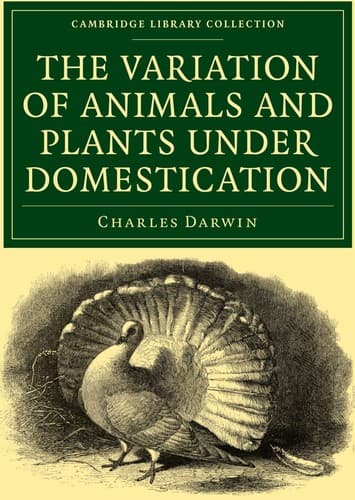
Like many other naturalists of his time, Darwin was receptive to the
idea of telegony, also known as “the influence of the previous sire.”
He retailed the famous story of Lord Morton’s mare, a chestnut of
seven-eighths Arabian blood, whose first foal had been sired by a
quagga (a now-extinct relative of the zebra) her owner was attempting
to domesticate. It was not surprising that the young hybrid faintly
echoed his father’s stripes, but the fact that her next two foals, both
sired by a black Arabian horse, also seemed to resemble the quagga in
this regard, was more remarkable. Darwin pointed out that atavism
offered one possible explanation of this phenomenon—infant horses and
donkeys often showed evanescent striping, which might indicate the
pattern of their ancient shared progenitor—but he was also drawn to the
notion that the first male to impregnate a female left some permanent,
heritable trace of himself behind. He offered analogous examples from
the vegetable kingdom, where the pollen of related varieties of apples,
corn, or orchids, could not only produce hybrid offspring but
occasionally also physically alter the reproductive tract of the
female. Plants also, and more regularly, demonstrated a kind of
variability that could arise independently of sexual reproduction, such
as “bud variation,” whereby what Darwin called a “monstrosity” might
appear on a single branch or flower and then be transmitted, sexually
or asexually, to future generations.
As he documented the profusion of variation among domesticated animals
and plants, and the tendency of organisms to transmit these variations
down the generations, Darwin did more than demonstrate that there was
ample grist for the mill of natural selection. He also addressed the
most serious weakness in the argument of the _Origin._ Despite the
incompleteness of the fossil record, plenty of evidence suggested that
evolution had taken place; indeed the idea of evolution had been
current in one form or another for a century before 1859. Darwin’s
explanation of the way that natural selection should operate was also
widely persuasive. The competitive metaphors with which he
characterized it, especially the “struggle for life” prominently
featured in the _Origin_’s subtitle, fit well with Victorian
understandings about how things worked in the human arenas of industry,
commerce, and geopolitics. There was, however, a problem that troubled
those inclined to sympathize with Darwin’s reasoning as well as those
inclined to reject it. The efficacy of natural selection, like that of
artificial selection, depended on the inheritance of particular traits.
But before the modern understanding of genetics became available, no
satisfactory mechanism had been adduced to explain this phenomenon. No
consensus yet existed about the way that sexual reproduction worked, so
there was also disagreement about which characteristics were inherited
and which were the result of environment, and what could he contributed
Public-domain text, read in full here on John Shaqi.
Reviews
Reviews
No reviews yet
Be the first to share your thoughts on this work.
Join the Discussion
Join the discussion
Sign in to leave a comment or review.
Sign InorCreate an account