I have heard it remarked as a strange circumstance that we occasionally
hear of the local or complete extinction of domestic races, whilst we
hear nothing of their origin. How, it has been asked, can these losses
be compensated, and more than compensated, for we know that with almost
all domesticated animals the races have largely increased in number
since the time of the Romans? But on the view here given, we can
understand this apparent contradiction. The extinction of a race within
historical times is an event likely to be noticed; but its gradual and
scarcely sensible modification through unconscious selection, and its
subsequent divergence, either in the same or more commonly in distant
countries, into two or more strains, and their gradual conversion into
sub-breeds, and these into well- marked breeds are events which would
rarely be noticed. The death of a tree, that has attained gigantic
dimensions, is recorded; the slow growth of smaller trees and their
increase in number excite no attention.
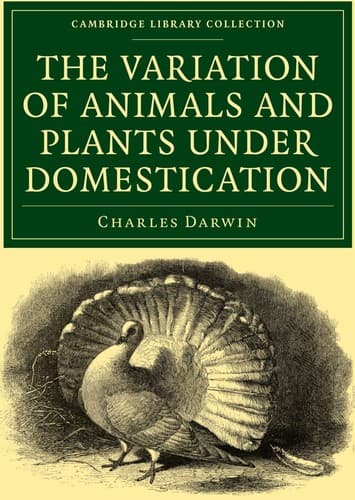
In accordance with the belief in the great power of selection, and of
the little direct power of changed conditions of life, except in
causing general variability or plasticity of organisation, it is not
surprising that dovecot-pigeons have remained unaltered from time
immemorial; and that some toy-pigeons, which differ in little else
besides colour from the dovecot-pigeon, have retained the same
character for several centuries. For when one of these toy-pigeons had
once become beautifully and symmetrically coloured,—when, for instance,
a Spot had been produced with the crown of its head, its tail, and
tail-coverts of a uniform colour, the rest of the body being
snow-white,—no alteration or improvement would be desired. On the other
hand, it is not surprising that during this same interval of time our
highly-bred pigeons have undergone an astonishing amount of change; for
in regard to them there is no defined limit to the wish of the fancier,
and there is no known limit to the variability of their characters.
What is there to stop the fancier desiring to give to his Carrier a
longer and longer beak, or to his Tumbler a shorter and shorter beak?
nor has the extreme limit of variability in the beak, if there be any
such limit, as yet been reached. Notwithstanding the great improvement
effected within recent times in the Short-faced Almond Tumbler, Mr.
Eaton remarks, “the field is still as open for fresh competitors as it
was one hundred years ago;” but this is perhaps an exaggerated
assertion, for the young of all highly-improved fancy birds are
extremely liable to disease and death.
Public-domain text, read in full here on John Shaqi.
Reviews
Reviews
No reviews yet
Be the first to share your thoughts on this work.
Elsewhere in the archive
Join the Discussion
Join the discussion
Sign in to leave a comment or review.
Sign InorCreate an account