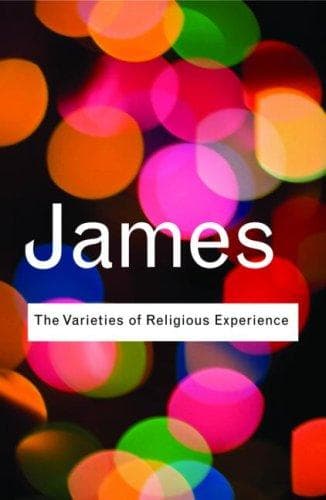
The Varieties of Religious Experience: A Study in Human Nature — John Shaqi
The Varieties of Religious Experience: A Study in Human NatureJames, William
ReligionComparative
The Varieties of Religious Experience: A Study in Human Nature
James, William
Conversion; Experience (Religion); Philosophy and religion; Psychology, Religious; Religion
In the psychologies and in the philosophies of religion, we find the
authors attempting to specify just what entity it is. One man allies it to
the feeling of dependence; one makes it a derivative from fear; others
connect it with the sexual life; others still identify it with the feeling
of the infinite; and so on. Such different ways of conceiving it ought of
themselves to arouse doubt as to whether it possibly can be one specific
thing; and the moment we are willing to treat the term “religious
sentiment” as a collective name for the many sentiments which religious
objects may arouse in alternation, we see that it probably contains
nothing whatever of a psychologically specific nature. There is religious
fear, religious love, religious awe, religious joy, and so forth. But
religious love is only man’s natural emotion of love directed to a
religious object; religious fear is only the ordinary fear of commerce, so
to speak, the common quaking of the human breast, in so far as the notion
of divine retribution may arouse it; religious awe is the same organic
thrill which we feel in a forest at twilight, or in a mountain gorge; only
this time it comes over us at the thought of our supernatural relations;
and similarly of all the various sentiments which may be called into play
in the lives of religious persons. As concrete states of mind, made up of
a feeling _plus_ a specific sort of object, religious emotions of course
are psychic entities distinguishable from other concrete emotions; but
there is no ground for assuming a simple abstract “religious emotion” to
exist as a distinct elementary mental affection by itself, present in
every religious experience without exception.
As there thus seems to be no one elementary religious emotion, but only a
common storehouse of emotions upon which religious objects may draw, so
there might conceivably also prove to be no one specific and essential
kind of religious object, and no one specific and essential kind of
religious act.
‐‐‐‐‐‐‐‐‐‐‐‐‐‐‐‐‐‐‐‐‐‐‐‐‐‐‐‐‐‐‐‐‐‐‐‐‐
The field of religion being as wide as this, it is manifestly impossible
that I should pretend to cover it. My lectures must be limited to a
fraction of the subject. And, although it would indeed be foolish to set
up an abstract definition of religion’s essence, and then proceed to
defend that definition against all comers, yet this need not prevent me
from taking my own narrow view of what religion shall consist in _for the
purpose of these lectures_, or, out of the many meanings of the word, from
choosing the one meaning in which I wish to interest you particularly, and
proclaiming arbitrarily that when I say “religion” I mean _that_. This, in
fact, is what I must do, and I will now preliminarily seek to mark out the
field I choose.
Public-domain text, read in full here on John Shaqi.
Reviews
Reviews
No reviews yet
Be the first to share your thoughts on this work.
Join the Discussion
Join the discussion
Sign in to leave a comment or review.
Sign InorCreate an account