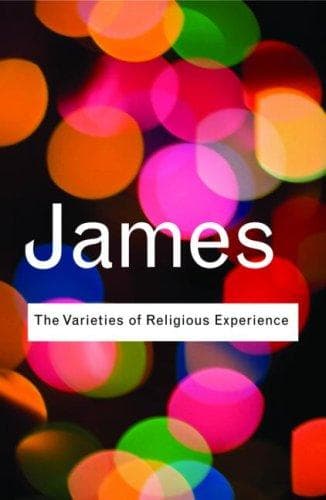
The Varieties of Religious Experience: A Study in Human NatureJames, William
ReligionComparative
The Varieties of Religious Experience: A Study in Human Nature
James, William
Conversion; Experience (Religion); Philosophy and religion; Psychology, Religious; Religion
“And this is why our holy founder wished the superiors to test
their monks somewhat as God tested Abraham, and to put their
poverty and their obedience to trial, that by this means they may
become acquainted with the degree of their virtue, and gain a
chance to make ever farther progress in perfection, ... making the
one move out of his room when he finds it comfortable and is
attached to it; taking away from another a book of which he is
fond; or obliging a third to exchange his garment for a worse one.
Otherwise we should end by acquiring a species of property in all
these several objects, and little by little the wall of poverty
that surrounds us and constitutes our principal defense would be
thrown down. The ancient fathers of the desert used often thus to
treat their companions.... Saint Dositheus, being sick‐nurse,
desired a certain knife, and asked Saint Dorotheus for it, not for
his private use, but for employment in the infirmary of which he
had charge. Whereupon Saint Dorotheus answered him: ‘Ha!
Dositheus, so that knife pleases you so much! Will you be the
slave of a knife or the slave of Jesus Christ? Do you not blush
with shame at wishing that a knife should be your master? I will
not let you touch it.’ Which reproach and refusal had such an
effect upon the holy disciple that since that time he never
touched the knife again.” ...
“Therefore, in our rooms,” Father Rodriguez continues, “there must
be no other furniture than a bed, a table, a bench, and a
candlestick, things purely necessary, and nothing more. It is not
allowed among us that our cells should be ornamented with pictures
or aught else, neither armchairs, carpets, curtains, nor any sort
of cabinet or bureau of any elegance. Neither is it allowed us to
keep anything to eat, either for ourselves or for those who may
come to visit us. We must ask permission to go to the refectory
even for a glass of water; and finally we may not keep a book in
which we can write a line, or which we may take away with us. One
cannot deny that thus we are in great poverty. But this poverty is
at the same time a great repose and a great perfection. For it
would be inevitable, in case a religious person were allowed to
own superfluous possessions, that these things would greatly
occupy his mind, be it to acquire them, to preserve them, or to
increase them; so that in not permitting us at all to own them,
all these inconveniences are remedied. Among the various good
reasons why the company forbids secular persons to enter our
cells, the principal one is that thus we may the easier be kept in
poverty. After all, we are all men, and if we were to receive
people of the world into our rooms, we should not have the
strength to remain within the bounds prescribed, but should at
Public-domain text, read in full here on John Shaqi.
Reviews
Reviews
No reviews yet
Be the first to share your thoughts on this work.
Elsewhere in the archive
Join the Discussion
Join the discussion
Sign in to leave a comment or review.
Sign InorCreate an account