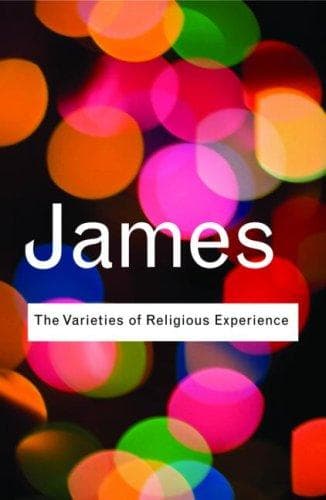
The Varieties of Religious Experience: A Study in Human NatureJames, William
ReligionComparative
The Varieties of Religious Experience: A Study in Human Nature
James, William
Conversion; Experience (Religion); Philosophy and religion; Psychology, Religious; Religion
A genuine first‐hand religious experience like this is bound to be a
heterodoxy to its witnesses, the prophet appearing as a mere lonely
madman. If his doctrine prove contagious enough to spread to any others,
it becomes a definite and labeled heresy. But if it then still prove
contagious enough to triumph over persecution, it becomes itself an
orthodoxy; and when a religion has become an orthodoxy, its day of
inwardness is over: the spring is dry; the faithful live at second hand
exclusively and stone the prophets in their turn. The new church, in spite
of whatever human goodness it may foster, can be henceforth counted on as
a staunch ally in every attempt to stifle the spontaneous religious
spirit, and to stop all later bubblings of the fountain from which in
purer days it drew its own supply of inspiration. Unless, indeed, by
adopting new movements of the spirit it can make capital out of them and
use them for its selfish corporate designs! Of protective action of this
politic sort, promptly or tardily decided on, the dealings of the Roman
ecclesiasticism with many individual saints and prophets yield examples
enough for our instruction.
The plain fact is that men’s minds are built, as has been often said, in
water‐tight compartments. Religious after a fashion, they yet have many
other things in them beside their religion, and unholy entanglements and
associations inevitably obtain. The basenesses so commonly charged to
religion’s account are thus, almost all of them, not chargeable at all to
religion proper, but rather to religion’s wicked practical partner, the
spirit of corporate dominion. And the bigotries are most of them in their
turn chargeable to religion’s wicked intellectual partner, the spirit of
dogmatic dominion, the passion for laying down the law in the form of an
absolutely closed‐in theoretic system. The ecclesiastical spirit in
general is the sum of these two spirits of dominion; and I beseech you
never to confound the phenomena of mere tribal or corporate psychology
which it presents with those manifestations of the purely interior life
which are the exclusive object of our study. The baiting of Jews, the
hunting of Albigenses and Waldenses, the stoning of Quakers and ducking of
Methodists, the murdering of Mormons and the massacring of Armenians,
express much rather that aboriginal human neophobia, that pugnacity of
which we all share the vestiges, and that inborn hatred of the alien and
of eccentric and non‐conforming men as aliens, than they express the
positive piety of the various perpetrators. Piety is the mask, the inner
force is tribal instinct. You believe as little as I do, in spite of the
Christian unction with which the German emperor addressed his troops upon
their way to China, that the conduct which he suggested, and in which
other Christian armies went beyond them, had anything whatever to do with
the interior religious life of those concerned in the performance.
Public-domain text, read in full here on John Shaqi.
Reviews
Reviews
No reviews yet
Be the first to share your thoughts on this work.
Elsewhere in the archive
Join the Discussion
Join the discussion
Sign in to leave a comment or review.
Sign InorCreate an account